Experiential Music
While representing the environment is essential for creating the world within which the player will be immersed, a player does not simply exist passively within various regions of a game. As discussed in the previous chapter, musical representation of the environment enhances spatial perception by conveying qualities of the environment not derived from visuals alone. This type of representation forms the groundwork for the player to then engage in a meaningful experience within the game. These experiences are created by collections of phenomenological events consisting of kinetic components (what the player is physically doing) and affective components (the player's response to the ongoing action). The term "experience" can describe the player's interaction with the game at a variety of timescales including throughout the game as a whole or in shorter levels. For early arcade games, these levels were clearly defined by pauses in the gameplay and text that appeared on-screen such as "Level 1" and "Level 2", forming distinct experiential segments. By contrast, many recent narrative games feature large open worlds where the player may not follow a linear progression, and the boundary between levels and distinct experiences is blurred. I will use the term level to describe a segment of a game where the player remains in a similar environment while pursuing a particular quest. These quests can either follow the game's narrative by defining goal-based segments that the player must complete, or can be "side quests", optional explorations that the player can choose to complete. Levels form the core experience of the narrative in a video game, describing not only what is physically in the game, but what the player is doing: how they are playing the game.
The player creates experiences by performing an active role in progressing the game's story. This progression can take many forms including exploring different environments, fighting enemies, soaring through the sky, and so on. The types of experiences found throughout a game are limited only by the game developers' imagination, and are not necessarily tied to particular environments. In a video game, one can just as well run on top of a cloud or run through a cave, neither environment being necessary for the experience of running to take place. Sometimes, however, the experience is linked to the environment, such as sailing in the sea or soaring through the sky. This chapter will focus on experiences without environmental links in order to more precisely analyse features of the experience, rather than features of the environment. By forming an experience, narrative video games deepen the player's presence in the imagined world, boosting immersivity by giving the player a role in the story. Music representing an experience is therefore a more abstract form of musical representation than representation of the environment. Whereas environmental representation can draw upon perceived characteristics of the environment sensed independent of experience, experiential music attempts to directly connect the player to their experience of the narrative. As the player begins to play an active role in the environment in pursuit of a goal, they become immersed in both the environment and in the experience, moving beyond investment to build affective ties between themselves and the story: the events on-screen are not solely witnessed as in a film, but are actively partaken in and empathised with.
Music plays a vital role in realising the player's purpose in these experiences, lending credibility to the affective ties created by the gameplay. In building this connection, music more deeply links the player to their game character. Rather than the avatar being simply a collection of pixels to be controlled by moving a joystick, a part of the player becomes the character on screen as they experience the same excitement, fear, and sorrow promoted by the narrative. As Isabella van Elferen describes, "Affect is a vital and inevitable aspect of any musical experience: listening to music cannot but stir emotions, connotations or identifications" [2016: 35]. For the deepest level of immersion, these identifications between the player and game reinforce the player's role in shaping the narrative and the resulting emotional impact returned to the player. When this music appropriately enhances the narrative experience, Michiel Kamp describes the result as an "aesthetic experience". As he writes, "The random onset of the music turns the mundane ... activity of building shelter in Minecraft into a situation, an experience with qualities like 'mundaneness' that the music reflects and maps onto; the everyday becomes a moment of reflection on everydayness" [2024: 68]. While the type of experience remains the same, when the music appropriately reflects the experience, the result is a period of greater immersion in the moment where even a "mundane" experience becomes a time worth noting. Music brings greater focus to the game, moving beyond reflecting the events on-screen to directly immersing the player in their role as an influencer of those events, shifting gameplay from manipulation of an avatar to identification with that avatar.
As with environmental representation, the music's ability to connect the player to their avatar's experiences is limited by player literacy in video game music. Melanie Fritsch describes how the player develops literacy by learning and recognising musical signals associated with ludic gameplay experiences [2016]. For instance, a sonic cue that plays every time the player dies (such as the chromatic Death sequence in Kirby's Return to Dream Land (Return to Dream Land)) will quickly become associated with restarting a segment of the game. Much like how composers draw upon established musical traditions to appeal to player literacy in representing the environment, composers can also draw on literacy in encountering music accompanying experiences to convey information about the quality of that experience. Drawing upon this literacy allows composers to quickly convey specific information about the gameplay experience, deepening immersion by further connecting the player with the story [2016].
In this chapter, I will discuss three stages of experience that appear often in the levels of narrative video games: the onset of adventure, the experience of progression, and facing conflict. These experiences describe the beginning, middle, and end of the player's journey through a level. Narrative games often include times of exploration such as the beginning of the game when the player first embarks on their adventure into the wider game world. These are the player's first interactions with an unfamiliar game, a time when each encounter is new, and they are encouraged to explore the world freely. During the adventure, the player experiences a combination of focus towards an eventual destination while remaining uncertain about the path that their journey will take, this level consisting of a combination of a known "quest" and unknowable obstacles. As they progress through the game, players will often face conflict as enemies stand in their path. The most extreme form of this conflict is the "boss battle", where the player engages in a difficult fight against a very powerful enemy. These battles typically mark significant cadences in the narrative where the player must overcome a challenging gauntlet to progress, presenting players with a challenge of sustained tension which requires focus and skill to succeed in.
The adventure and the boss battle are essential parts of experiencing any video game level. When exploring at the beginning of a game, the player must develop mechanical skills and knowledge of the game's mechanics to progress. Faced with an uncertain future, the only familiarity becomes their growing comfortability with how their on-screen character moves. As the player approaches a story cadence, however, they grow by overcoming challenges, and very little uncertainty remains: by the end, they have already witnessed the entire journey. The boss battle creates an identifiable "ending" to each level, a moment in the game where the player's knowledge and skills are tested in a difficult experience that could, in some cases, take hours to surpass. By analysing music that drives the adventure and this climactic conflict, this chapter examines two events that occur at opposing parts of the video game narrative, investigating what compositional techniques enhance the player's affective response and deepen immersion during these experiences.
While here I focus on how composers craft experiences in video games, music's ties to how we experience the world are not solely limited to games. I hope that this chapter will serve as a useful tool for understanding how music turns images and moments into dynamic experiences. Kamp's description of music creating "aesthetic experiences" extends beyond video games to the music listened to in everyday life. Investigating music that accompanies video game experiences invites us to think on how our choices of music can contribute to increased immersion both in video games and in our lives more broadly: how might music create a greater sense of presence in the everyday life, just as it does in narrative video games?
Adventuring
The Experience of Adventure
When one becomes immersed in a narrative video game, they are transported from the real world into a fiction in which an adventure takes place. This adventure marks a break from the ordinary, and can range from simply taking care of a farm to embarking on a grand quest to save the world. As the player engages with the video game, they are given the opportunity to become the hero of a fantasy world, experiencing a journey which could be impossible in real life. Writing on the phenomenology of this engagement, Professor of Digital Media Melanie Swalwell describes how the player becomes a part of this adventure, projecting themself "into the games space and responding to its movements, moving with it" [2011: 3]. In narrative video games, a player does not simply bear witness to an adventure unfolding, but takes active part in that exploration and journey, becoming the character that moves through the game.
Philosopher Simon Gusman identifies the general characteristics of adventure through an analysis of theories by Georg Simmel and Vladimir Jankélévitch that highlight the importance of this experience's beginning, middle, and end. From Simmel's perspective, the most distinct quality of an adventure occurs at the start of the journey, which creates a discontinuity from the everyday life. Simmel proposes that this "everyday" consists of a "coherent chain of events" [Gusman 2023: 3] which is disrupted at the onset of adventure: this experience is primarily defined not by its specific qualities, but by its unusuality. Due to this fixed period of disruption, adventures become experiences with "strictly defined boundaries" in time [3]. In particular, embarking on an adventure has a distinct starting point, a time of trepidation where the adventurer leaves behind the familiar to explore the unknown. To describe the ending of the adventure, Simmel identifies that these journeys are goal-focused, framing this experience as one with a specific finish in mind. For instance, the experience of climbing a mountain is focused on the goal of reaching the peak. This is a goal that persists throughout adventuring, always urging the player onwards and promoting constant movement.
While many adventures are framed around their end goals, however, the destination does not fully describe the journey. Writing on the experience of this journey, Jankélévitch proposes a less goal-focused view of the adventure, emphasising instead the aspect of "anticipation" central to the adventuring experience [Gusman 2023: 12]. Particularly relevant to the adventures encountered in video games is the indeterminate nature of the future. One may set off to climb a mountain knowing that their goal is to reach the peak while possibly having only a vague idea of the specifics that their adventure will take. They may know the general route, but have no way to predict each boulder that must be traversed, each loose pebble waiting to tumble down the slope. In a game, the player may similarly know that they must reach a certain location (such as a village or castle), but are typically unaware of the encounters that will lead them to that destination. Gusman quotes that "Jankélévitch stresses the fact that adventure embodies both certainty and uncertainty. This ambiguity is the most fundamental aspect of adventure (Jankélévitch 1963, 10–11). The future is ambiguous, because we do know that it will happen, but do not know what is going to happen" [2023: 12]. These quests are not undertaken meaninglessly, but rather carry a combination of uncertainty, excitement, fear, and freedom. To leave that which is familiar is invigorating, and to embark on an adventure in a video game means exploring a world where everything is new and unfamiliar. This unknown may initially seem to induce trepidation or fear, but philosopher Simon Perrier proposes that adventures are enticing because of their unknowability. He writes that adventures are "desirable even if we do not really know what to expect, desirable precisely because we do not know" [2018: 48].[1] In other words, the attribute of an adventure that makes the quest exciting is not only the break from the familiar and the everyday, but the sense of unknown induced by exploring an unpredictable future. This experience starts with a break from the ordinary, is guided by the certainty of the destination (or at least, a sense that it is certain), and is characterised by an uncertainty in the manifestation of the journey, a strange blend of emotions that captures both eagerness and trepidation.
This section will analyse the experience of adventuring and exploring across four video games that feature a musical shift at narrative moments where the player has just gained access to a new way to adventure. For the games Hollow Knight: Silksong (Silksong) and Ori and the Blind Forest (Blind Forest), I will analyse the music that accompanies the player's first moment of exploration in the narrative. These tracks support not just the player's adventure into a new region, but into the entire game, displaying a time when every aspect of the game is new and unfamiliar. In Ori and the Will of the Wisps (Will of the Wisps), the player learns a new ability called "Bash" early in the game that expands their ability to traverse terrain and move quickly through the world. As they begin to experiment with this new way of exploring the world, the track Dashing and Bashing plays, urging experimentation with this new skill. Last, in The Legend of Zelda: Breath of the Wild (BotW), any time the player rides a horse, they gallop along to Riding - Day, a quick piano tune that urges movement and exploration. Throughout these tracks, movement is conveyed through ostinatos and swift melodic ideas, and the combination of certain and uncertain is conveyed through harmony, mode, voicing, and form.
Movement through Ostinatos
Essential to an adventure is the departure from the known and the venture into the unfamiliar which grounds the experience of adventuring in movement—the player must keep moving forward, lest their surroundings become too familiar, returning the adventure to the ordinary. In game scores, this movement is most often conveyed through ostinatos and quick melodic ideas which accompany the player's journey, urging them on to adventure and explore. Through repeating lines that accompany the in-game adventuring, composers evoke the kinetic qualities of adventuring by travelling on foot or by horse, convincing the player that they are taking part in a grand quest despite not moving in the real world.
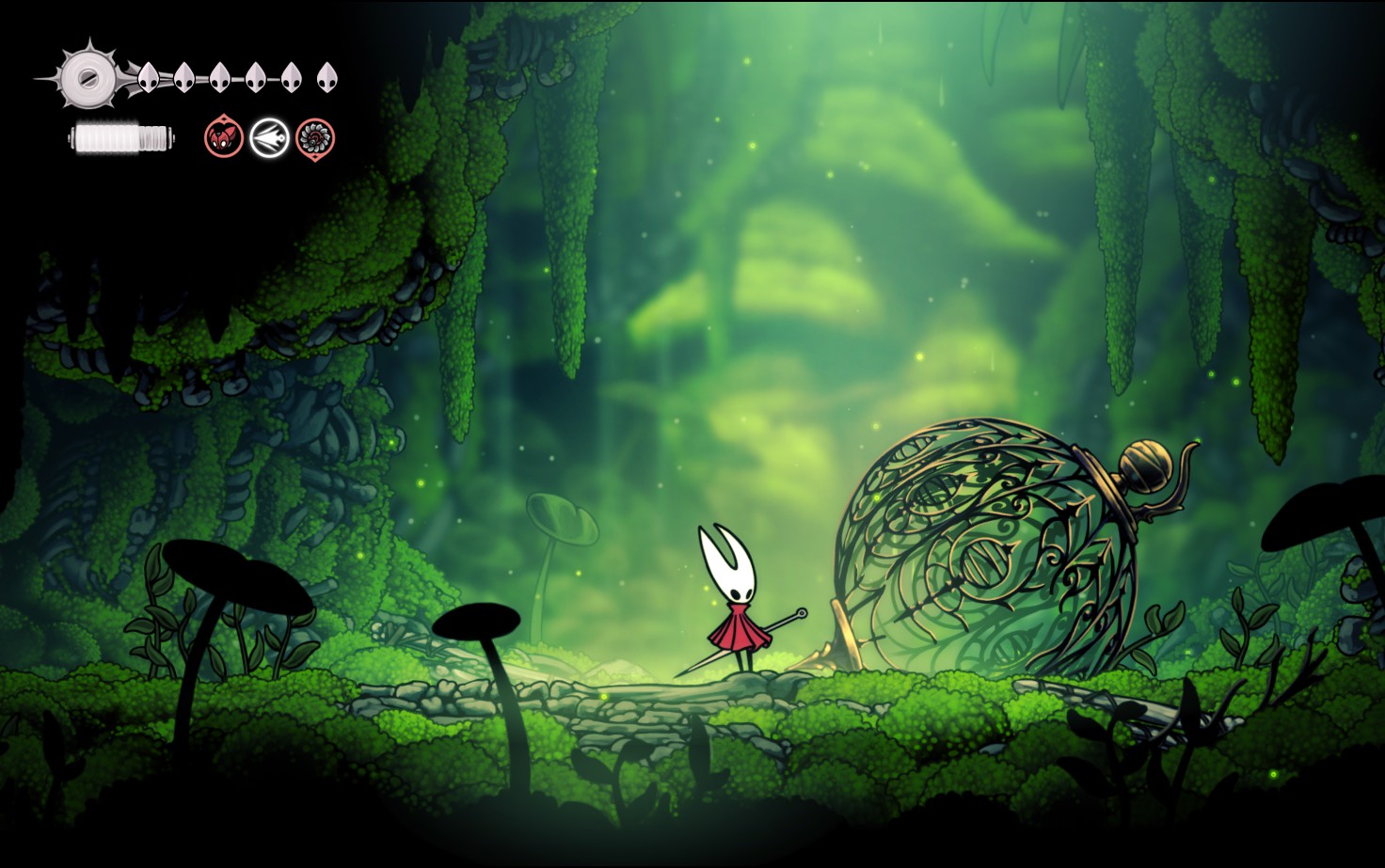
Silksong's Moss Grotto has a particularly distinct, yet simple ostinato played by a harp in simple quadruple metre. The Moss Grotto is the first region the player is able to explore in the game, their first adventure embarked upon once they gain control of their character. This is an area of lush mossy greens and relatively few enemies where the player can find their bearings in the game and learn the controls, as shown in Fig. 3.1.
For the majority of the track, this ostinato alternates between a B and an E in the key of E minor, adjusting slightly for the harmony in places, as shown in Ex. 3.1. By inverting the i chord in this ostinato, Christopher Larkin creates a sense of suspension without leaving the tonic that keeps the player lifted away from stillness.
![First melody to 'Moss Grotto' from Hollow Knight: Silksong, transcribed by sebastienskaf [2025] and organised by author.](/thesis/music/images/mossgrotto_score.png)
This ostinato communicates that though the environment may feel comforting and welcoming, it is not itself a home or place for rest, but rather a journey towards an ending. Coming at the beginning of the game, this suspension immediately urges the player to begin moving, marking the onset of the adventure: as soon as the player enters the game world, Larkin's music encourages travelling by preventing stagnation.
As the player explores more of the Moss Grotto, the harp ostinato expands to arpeggiating chords instead of simply moving between B and E. Accompanying this development, Larkin writes more embellishing material in the glockenspiel and a hang drum. All instruments move between playing the melody (often multiple instruments at once) and playing embellishing textural material, creating many overlapping rhythms that contribute to a constant sense of movement. Through these layers, the rhythm of the ostinato is still heard faintly, falling into the strong beats to indicate a continuous trot forwards. Slowly, the ostinato shifts from solely representing the onset of adventure to also encouraging progression. Now, the player has departed from the familiar and must keep progressing forwards. They are accompanied by the same urge that moved them away from stillness, a lingering sense of movement that becomes a representation of the middle of the adventure. By its regularity and inversion, this ostinato banishes any possibility of stillness, urging the player to explore and progress through the game away from their starting location.
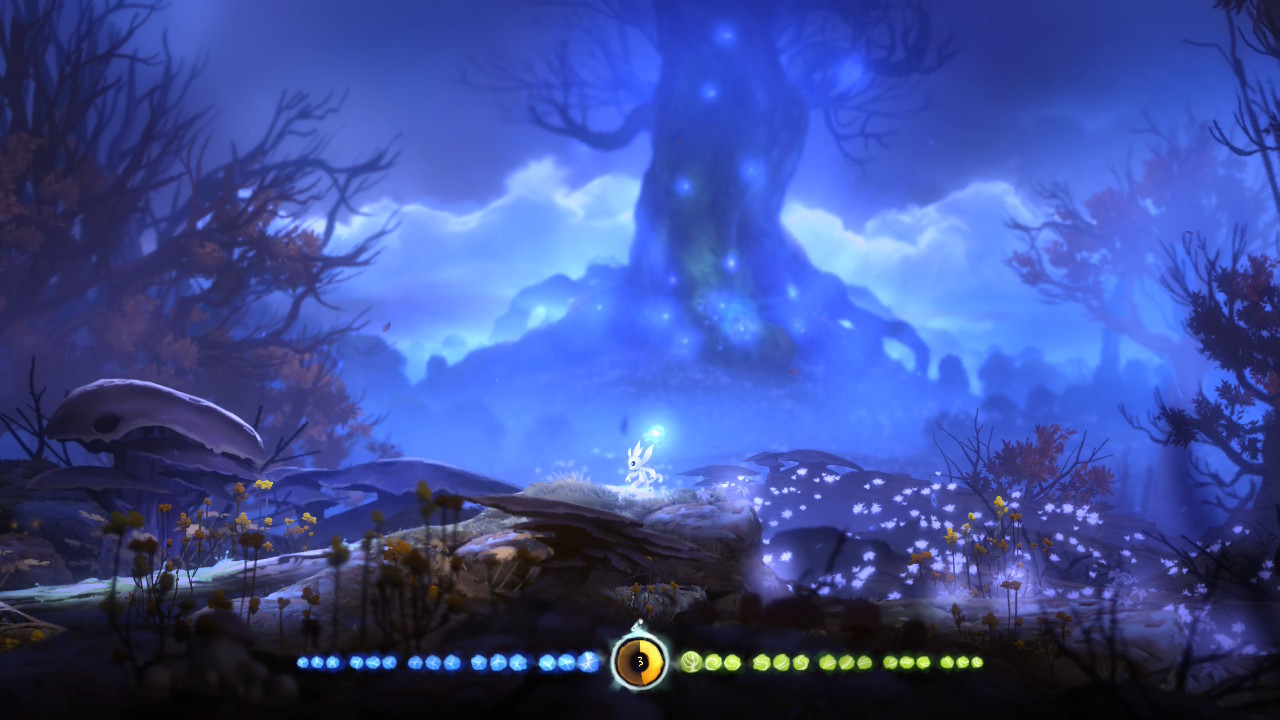
When the player first gains control of their character after an introductory cutscene in Blind Forest, the music First Steps Into Sunken Glades welcomes them to the world with a soft piano melody. The player finds themselves awakening in a dark forest clearing with the "spirit tree" seen in the distance, as shown in Fig. 3.2. The player's ultimate goal throughout the narrative is to revive this tree, restoring life to the forest.
Unlike the immediate urge to move created by Moss Grotto, Gareth Coker gives the beginning of First Steps Into Sunken Glades a soft quality using a piano to create atmosphere, ensuring that the player is not overwhelmed by a large, new world, but is rather able to explore peacefully with curiosity. As they explore further, the music rhythmically accelerates to accompany their exploration, shifting to a representation of the middle of the adventure. Cellos enter with a softly driving eighth note pulse along with a wave-like piano ostinato which arpeggiates chords in D minor, as shown in Ex. 3.2.
![The middle of 'First Steps Into Sunken Glades' from Ori and the Blind Forest, transcribed in part by Hornet's Flight [2020] and organised by author.](/thesis/music/images/sunken_glades_score.png)
For a significant part of the track, the cellos maintain this pulse, urging the player to move forward and progress, exploring this new world as they begin their adventure into the story. Coker's choice to delay the entrance of the driving pulse is particularly interesting due to its contrast to Larkin's harp ostinato in Moss Grotto beginning nearly immediately. In Silksong, the player is encouraged to explore as quickly as possible in order to ascend to the peak of the world on a quest for revenge, while in Blind Forest the narrative sets up less time pressure, indicating that the player's quest is urgent, but that many dangers lie ahead, so caution is necessary. Once the player gains their bearings with the controls and can start to move more freely about the world, Coker introduces the low strings pulse and piano ostinato which encourage the player to bravely explore their surroundings.
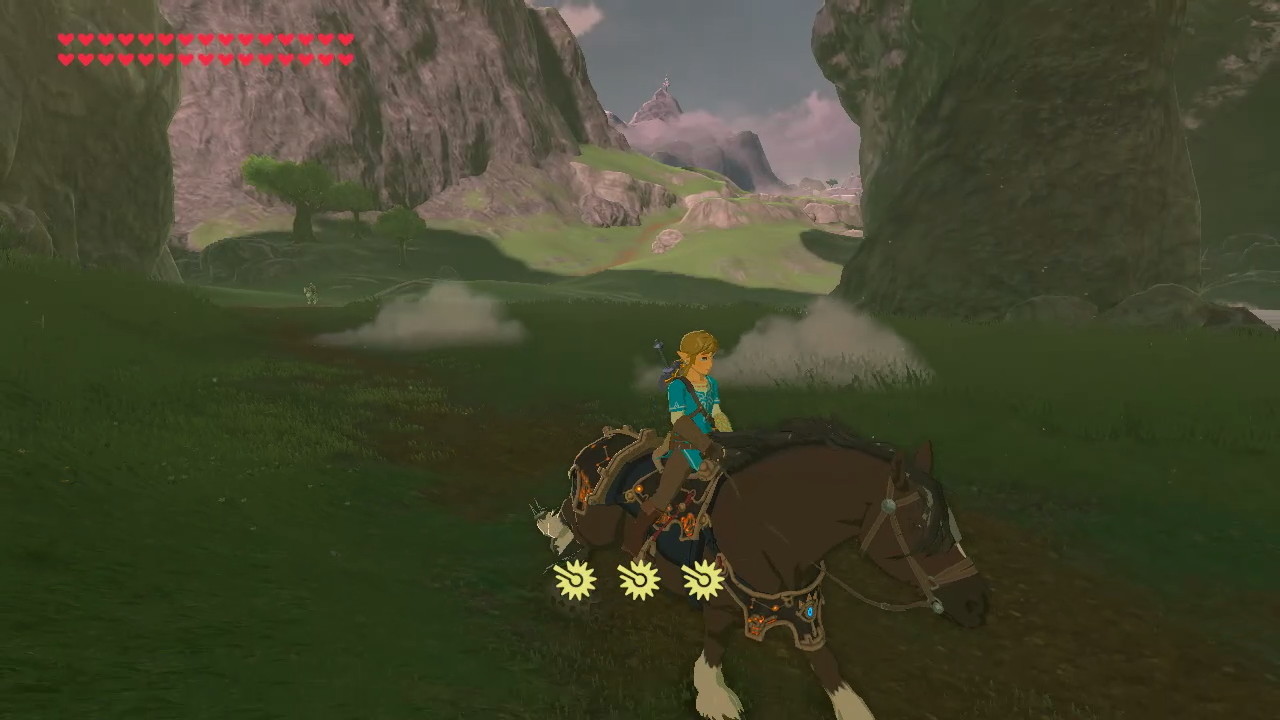
A third game which emphasises this sense of movement while adventuring is BotW, which plays the tune Riding - Day each time the player gallops on a horse (but only during the daytime; a separate tune, Riding - Night, plays at night). An image of a player riding a horse in BotW is shown in Fig. 3.3.
This theme revolves around a quickly moving lower voice on a piano that conveys a clear tempo primarily through staccato notes and dyads. Syncopated against this clear rhythm are repeated melodic lines in the piano's upper voice, and at some parts in the track sustained violin and viola lines. Central to this track are the short repeated melodic fragments in the piano upper voice shown in Ex. 3.3. These lines cast the music playfully, using agility and regularity to indicate constant movement. Typically, the upper voice plays in groups of four sixteenth notes the first three times it appears and in five the fourth time, as can be seen in the first three systems of Ex. 3.3.
![The beginning to 'Riding (Day)' from The Legend of Zelda: Breath of the Wild, transcribed by Kian M [2018] and organised by author.](/thesis/music/images/riding.png)
In the fourth system, the rhythms shift slightly, with only three notes in this upper voice the first and third times they are played. These subtle shifts introduce slight change into a foundation of familiarity and movement. The recurrence of the treble line gives the player a repeated idea to focus on, but the changes imitate the imperfections intrinsic to exploring varying terrain. Rather than directly representing the rhythm one would hear listening to a galloping horse, the composers instead more abstractly evoke the experienced steadiness of the gallop through repetition of this melodic idea which remains fairly regular, but occasionally shifts.
The quality of the adventure most conveyed through ostinatos and quickly repeated melodic ideas is the sense of constant movement created by venturing away from the familiar. The adventure is an experience described by a journey that progresses towards a fixed destination, a time when one cannot remain still, but must keep travelling forward. Whether the player is taking their first steps into the game world or galloping through a field of grass, they find themself exploring novel environments, pushing forward towards an end goal for their adventure. Also noteworthy in each of these examples (and a fourth example, as will be seen soon) is that composers write with a tempo of around 90 BPM. While four tracks is too small of a sample size for making a meaningful statement about the correlation between this tempo and a sense of adventuring, 90 BPM effectively creates a sense of moving forward, but not too eagerly. The repetition of the ostinato sonically reflects this constant movement, so that even if the player pauses for a moment in their gameplay, the soundtrack maintains this experience's sensation of moving forward in one's adventure.
The Known and the Unknown
Adventures are undertaken with goals and destinations in mind, and while that overall quest may at times become vague, this driving motivation remains a constant "knowable" upon which the adventure is founded. This clear sense of purpose is pitted against the feeling of uncertainty intrinsic to the journey, forming a strange mix of excitement and trepidation. Musically, this sense of purpose can be implied using harmony, while the uncertainty and unpredictability can be conveyed through mode and overlapping textures. To demonstrate the tension between the known and the unknown, composers use a juxtaposition of driving harmony, suspension, and complicated rhythms (this combination also showed up in Chapter 2 with the discussions of Dreaming of Clouds and Reach for the Summit, which both marked explorations into an uncertain sky), retaining a sense of overall drive while representing the experienced complexity of the adventure.
Larkin conveys this constant progression towards a goal through bass movement in Moss Grotto, but maintains the sense of the unknown through modal mixture and harmonic inversion. As the player travels deeper into the region, Larkin often distinctly uses the third and fourth scale degrees in the lower voice of the ostinato to promote a sense of forward movement towards the five (as seen in bars three and four, seven and eight, and eleven in Ex. 3.1). By keeping the tonic inverted, Larkin maintains a sense of moving towards a goal without reaching it yet. Throughout the track, Larkin also uses stepwise motion of the second and third scale degrees to approach the major subdominant. Combining this with both C-naturals and C-sharps in the melody and in embellishing musical material, the music smoothly flows between E minor, E dorian, and A major with significant modal mixture. Just as this modal ambiguity in the sky environment creates a sense of suspension and openness to the atmosphere, the recurrence of this harmony for this experience of the unknowable adventure creates a sensation of an uncertain future while using stepwise motion in the bass to maintain the feeling of progressing towards a goal. By shifting the mode throughout the music, Larkin subtly indicates that this quest is complicated, where the ending of the adventure is possibly further than one thinks it is.
The modal mixture impacts how Larkin's melody—centred around leaps of a fourth—is perceived. As shown in Ex. 3.1, the melody begins on a flute with a leap of a fourth from B to E, the same interval prevalent in the harp ostinato. This motive can also be seen in embellishing material such as the glockenspiel line (shown as cue notes in bar two), which ends with a similar leap of a perfect fourth from B to E. Despite landing on the first scale degree, the use of dorian leads to this motive being perceived as an open fourth instead of a five to one movement, creating a sense of suspension that delays resolution. This suspension at once contributes to the uncertain nature of the adventure to convey unpredictability for the future and creates space for the harmonic progression to indicate progress towards a goal which is not yet attained.
Creating a similar sense of suspension, BotW's Riding - Day uses contrasting rhythms and an A-flat lydian scale to contribute to a sense of progression towards an eventual goal. Unlike Moss Grotto, the melodic upper voice of the piano does not conform to the lower voice's harmony. Against this stable rhythm which clearly lays out a harmonic progression, the changing upper voice typically arpeggiates every other note of the A-flat lydian scale not present in the lower voice, less implying harmony than suspension around the scale. The theme stays entirely diatonic throughout its length, yet the lack of agreement in harmony between the two voices contributes to a similar lack of resolution. While the lower voice may clearly outline a harmony, landing on the I chord never feels perfectly resolved due to the chordal extensions created by the upper voice, the I chord itself being voiced as a quintal, and the use of lydian that creates an overall lifted feeling. In this case, the stable rhythm and clear harmony of the lower voice promote the movement towards a goal, while the suspended and slightly less regular upper voice reminds the player of the unknown that they are riding to. Together, the two voices create a combination of certainty of purpose and open possibilities held by the future.
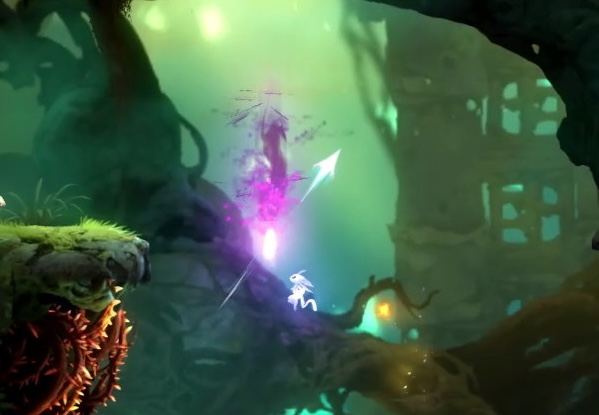
In Will of the Wisps, the player learns the "Bash" ability early on in their adventure as a way to expand their movement and exploration skills. A visual of this bash ability is shown in Fig. 3.4.
Once the player begins experimenting with their new ability, they are accompanied by the track Dashing and Bashing, which features a quick ostinato in the cellos, shown on the lower staff of Ex. 3.4. Harmonically, this track stays grounded in B minor, the primary melody following a double period where all phrases harmonically begin the same using the i and v chords. The second half of three out of the four phrases in this double period return to the i chord using a ♭VI–♭VII–i progression, creating a similar forward drive as in the stepwise bass motion in Moss Grotto.
![The beginning to 'Dashing and Bashing' from Ori and the Will of the Wisps, transcribed by LazyTotodile [2020] and organised by author.](/thesis/music/images/dashing_score.png)
As this piece progresses, it shifts between melodic and non-melodic sections, characteristic of Coker's compositional style. The low strings drive the pulse for the majority of the music, either through stepwise eighth note lines or through strong beats on quarter notes. Due to the music's quick tempo of half note 92 BPM, even textural sections that lack a distinct melody create a sense of environmental movement through overlapping layers and instrumental echoes, inviting the player to kinetically explore their newfound ability. While the music may allow the player to take a short moment to catch their breath, it never stagnates, consistently returning to the driving pulse that urges the player to move and explore.
Supporting the harmonic motion in Dashing and Bashing is the textural and harmonic rhythm. While each set of four bars uses four chords, the change to the second and fourth chords occurs on the fourth beat of a measure, rather than on the downbeat of the following bar. By placing the chord change just before the strong beat, Coker creates a slight rhythmic instability as the regularity of the cello line is pitted against the harmonic rhythm. This instability keeps the music from resting still, forcing the rhythm to always flow forward. As a consequence, Dashing and Bashing has a more complicated rhythmic texture that urges the player to explore. Using these textural combinations of rhythms, Coker conveys the dynamism intrinsic to adventuring while encouraging quick movement.
Though the adventure is a time of uncertainty where the familiar is left behind, exploration is exciting precisely because of its unknowable nature [Perrier 2018: 48]. To experience an adventure is to at once sense a constant drive towards one's goal, but also to recognise that the path to that goal is clouded in uncertainties. By mixing rhythmic foundations with harmonic and bass lines that progress towards a resolution that sometimes never comes, composers can craft this combination of sensations created by the adventure, keeping the player moving towards their goal while warning of the dangerous possibilities of the future.
Conflict
Whereas adventures describe the journey undertaken in pursuit of a quest's end, conflict is often the final barrier to completion of that quest, a test of all learned throughout the adventure. Narrative video games are often rife with conflict, most often in the format of battle against either small enemies that the player encounters while adventuring or against much more difficult enemies, "bosses", that must be defeated at significant story beats. In some games, such as Hollow Knight and Dark Souls,[2] these boss fights are so difficult that the player could fail hundreds of times across real-life hours or even days before succeeding and continuing on in the narrative. Other games, such as Return to Dream Land, are easier, and while these boss fights still mark significant story beats, the player is likely to emerge victorious within a couple of tries. In these fights, the game induces in the player the feeling of being in a battle despite remaining safe at home. To analyse this experience, this section will investigate the question: How does a video game use music to shift the player's experience from pushing buttons on a controller to becoming a warrior engaging in combat against a difficult enemy?
Mechanically, each boss typically has a select number of attack patterns that the player quickly learns to recognise and avoid. For the best players, these patterns are learned immediately, and the boss is quickly defeated. For many, these patterns are learned over dozens of repetitions of failure and perseverance. The boss fight is a trial of skill, a period of time in which the player actively learns, persists, and eventually succeeds. Similar to a real-life sparring bout, these battles often shift between short bursts of high action and the player waiting for a clear opening to attack, creating a constant sense of danger interrupted by brief flashes of dangerous action. As the player deals damage to this boss, the enemy will often evolve in what are called "phases". A common number of phases for a boss fight is three, though this is not in any way a definite rule. These phases usually grow progressively more difficult as the player comes closer to defeating the boss, sometimes adding variations to existing attack patterns to make them more challenging, and other times introducing entirely new attack patterns that the player must learn. The best boss fights can be the most memorable parts of a video game, and these fights are so useful for describing the narrative that when discussing games with others, I have often found myself conveying my progression by naming the most recent boss I had vanquished. The enemies faced range greatly in theme, with some being large, fiery monsters, while others may be shadow-based humanoid enemies, for example. The musical "boss themes" that accompany these fights vary just as much, reflecting the changing thematic nature of the boss. Common to these themes, however, is the conveyed sense of a difficult fight, as will be discussed throughout this section.
Unlike the experience of adventure or an environment such as the sky, being in a fight is not an experience in which everyone has partaken, save those who engage in martial arts. Like the cave, most can picture some idea of what it might be like to be in a fight, but physically brawling is not a core component of modern life. Nevertheless, a great amount of research has gone into investigating how humans respond to being in a fight, both psychologically and physiologically. Being exposed to dangerous physical or psychological stimuli induces a stress response that can disrupt the body in numerous ways, including increasing heart rate, quickening breathing, increasing blood pressure, and, if sustained over an extended period of time, by negatively impacting the skeletal and gastrointestinal systems (among others) [Chu, Marwaha, Sanvictores, Awosika, Ayers 2024]. At the same time, the one engaged in a fight must maintain constant attention on the battle, as a single mistake can spell disaster. This need for constant attention leads to mental strain and tension as the fight shifts between offensive and defensive action, each warrior attempting to find an opening to strike the other [Barreira, Telles, Gutiérrez-García, Andrieu 2025]. While video games never physically place the player in danger, a game that successfully immerses the player in the game—and here in the action—will have players' hearts pounding as they face a difficult enemy, palms sweating as they avoid certain death.
In these boss battles, players may struggle with the mechanical gameplay, and this can prove a significant challenge to immersion. I remember a particular personal experience while playing Silksong in which I struggled with a boss fight, but the score turned that struggle into immersion. I felt that my struggle came not from a failing to properly manipulate the controller (though that was, technically, the reason), but rather that I was an inexperienced duelist fighting an opponent more skilled than I, the music turning the encounter into an epic battle for life. Music can only accomplish so much, however, as evidenced by the number of players that quit difficult games upon being unable to progress past a certain difficult level or boss [Steam Community]. Experiencing a boss battle occurs primarily in three parts: the approach to the battle, the fight itself, and the victory (or repeated losses). In this section, I will discuss this approach to battle, which is notable for its common lack of music, and music's role in enhancing immersion by connecting the game fight to the experience of a real-life fight using militaristic instrumentation and by creating a constant sense of tension and focus.
The Approach to the Fight
The experience of a boss battle in a video game does not begin when the boss first appears on the screen, but before that as the player approaches the arena where the fight is to take place. In the real-world context of mixed martial arts, this approach to the fight manifests as "a period of mixed feelings: adrenaline, anxiety, fear, but also courage and happiness" [Telles, Vaittinen, Barreira 2018]. In video games, the same anticipation occurs, with the moment before battle in a game typically shifting from environmental music to full silence before the boss's theme begins playing. For particularly important battles, a cutscene plays before the fight, creating a temporary separation between gameplay and narrative that emphasises the climactic story beat. The music will often cut out at the end of these cutscenes, so that the player hears only sound effects. Then, as the boss appears on the screen, the boss's theme enters in full force and the player regains control of their character; the battle has begun.
In Silksong, this change is especially striking as the player shifts from being immersed in the music of Deep Docks—an epic, forlorn, choral atmosphere that conveys a tale of history, work, and grandeur in G minor—to silence interrupted only by Lace Humming[3] in D-flat minor, a tritone away. Lace is a boss woven of silk who is first seen conducting silk flies as shown in Fig. 3.5. She is notable for being about the same size as the player (many other bosses are much larger than they are), creating the impression of fighting a foe of similar background and ability. As the player approaches, a brief dialogue ensues in which Lace assures the player that they will be defeated, before she and the player leap into action to the theme Lace played by a string quintet.
![Lace from Hollow Knight: Silksong [Hollow Knight Wiki].](/thesis/music/images/lace.png)
Unlike the Lace battle, which the player effectively walks into without losing control of the character, both the final fight against Magolor (Fig. 3.6) in Return to Dream Land and the fight against Colgera (Fig. 3.7) in The Legend of Zelda: Tears of the Kingdom (TotK) are approached using cutscenes. As they approach the Magolor fight, the player has just finished defeating multiple of this boss's earlier stages, first by attacking his ship, then by fighting his original form. After this second phase, high-energy music cuts out as the player delivers what seems to be their final blows against the enemy, the sonic space filled only with the sound effects of a slicing sword. As Magolor seems to die, still no music plays as all goes white. At this point, it is likely that the player believes that they have won the battle, but the appearance of a new form to the beginning of the C-R-O-W-N-E-D theme starting on an arpeggiated i5 quintal indicates that there is still more to come. In this game, the disappearance of the music acts as a "calm before the storm", where the empty sonic atmosphere sets up a dramatic entrance of the boss theme.
![Magolor after being crowned in the game Kirby's Return to Dream Land [WiKirby 2026].](/thesis/music/images/crowned.png)
The Colgera fight in TotK similarly begins with a cutscene where the player must trigger an ancient device that frees the boss from a cage. During this process, no music is heard, the only sounds that of the clicking of archaic mechanisms. Here, the player can easily predict that a battle is coming, but the exact nature of their enemy is still unknown. The silence marks a moment of anticipation, building tension through a fear of the unknown that will be resolved only by the appearance of the boss. As Colgera is freed, the player is launched into the sky by a tornado, accompanied by the beginning of the Colgera Battle theme: a flute melody above a drone on the tonic and strings playing ascending and descending chromatic runs.
![Colgera from The Legend of Zelda: Tears of the Kingdom [GameSpot].](/thesis/music/images/colgera.png)
For games where the player is almost always accompanied by music, this moment preceding a fight where the music gives way entirely to sound effects is particularly potent in situating the experience of the fight. In much the same way that martial artists experience adrenaline before a fight, or new musicians may approach solo performances full of nerves, the distinct lack of music in the approach to the fight cues the player to begin anticipating battle, priming them for the action.
Militaristic Instrumentation and Drive
Many themes to boss fights in narrative video games utilise a full symphony orchestra, drawing especially on the percussion and brass sections. The prevalence of these instrument groups calls to a perception of music in real-world military use. Historically, war drums have been used extensively to convey battle signals across world cultures, and brass instruments such as the bugle and trumpet have an extensive repertoire of composed signals used to convey battlefield instructions [O'Keeffe 2025: 26]. Many modern militaries also maintain wind bands that, though rarely present on the battlefield itself, have strengthened the cultural association of brass and percussion in combat [O'Keeffe 2025: 4]. These associations give composers a shared musical literacy upon which to draw when composing for a battle.
One track that features this high presence of percussion and brass is the Colgera Battle theme, which utilises a tambourine and a timpani to very clearly drive the quarter notes of the quick tempo boss theme (176 BPM in simple quadruple metre). Along with this percussion section—which later adds snare, toms, and bass drum—all the strings repeat an ostinato playing the first four scale degrees of A-flat dorian, at once keeping the harmony fixed on the tonic while hinting at rising away from that foundation to engage in battle. The melody for this track is primarily carried by the woodwinds (as is fitting for a fight taking place in the sky, based on the findings of Chapter 2) and brass, alternating between long melodic passages, quick staccato lines, and, at one point in the track, a fast, highly syncopated melody. Often, this melody is carried by multiple woodwinds at once (sometimes with the first violins added in), creating a mixing of overtones that adds to textural complexity. When the tambourine is later joined by a snare, the overall effect is a constant rhythmic drive from the percussion section with organised melodic material in the winds carrying the piece's themes, a combination that calls to the instrumentation commonly associated with military bands and war signals.
C-R-O-W-N-E-D is similarly driven by its constant percussion, most notably a hi-hat playing the repeated rhythmic motive shown in Ex. 3.5. Accompanying the hi-hat, an anvil plays forte hits on the "and" of beat two and on beat four for a significant portion of the track.

In addition to the percussion section, Jun Ishikawa also uses the full orchestra to propel this rhythm. The cellos and basses clearly signal downbeats with a tresillo rhythm through the first two beats of each bar in the first section of the track. This rhythm is later augmented to fill the entire bar. Many of the melodies featured throughout this track[4] are played as sequences of repeated sixteenth notes, so that every aspect of the music promotes a sense of urgency. The music features no extended melodic lines, filling any moments when an instrument sustains a note with textural complexity. For instance, the violins may finish a quick line by sustaining the final note only for the horns to enter with an echo of the line beneath, shifting the player's sonic attention away from legato and onto the staccato elements of the music. While the presence of a full symphony orchestra driving the music diminishes the individual role of the brass throughout each section, large musical moments always feature the brass playing the melody. By using the brass in climactic moments, Ishikawa ensures that for times most likely to catch the player's attention, the brass is heard proudly holding the melody. In addition, this instrument section is often highlighted around modulation points. Throughout its length, the track modulates from F major to A-flat minor, then to E minor and C minor [WiKirby]. After each modulation, the melody is given to the brass, once again drawing the player's ear to instruments such as the trumpet and French horn. In doing so, Ishikawa evokes the military associations with these timbres, using percussion to constantly drive battle while highlighting grand moments with brass.
While not a necessary component of a boss fight in video games, a militaristic focus on percussion and brass to drive the music and accent cadences is a useful tool available to composers scoring battles. Due to the prevalence of these instrument groups in both war signals and in military bands, the use of these timbres creates an easier connection to conflict and battle than other instrument groups, a result of player literacy in the experience of battle.
Foundation and Tension
Essential to the experience of the boss fight is the player's sustained sense of tension from being pitted against a difficult enemy in an arena. Throughout these fights, there are generally no moments of rest; the player must maintain constant focus on the game in order to avoid certain death and ensure victory over their opponent. Just as the music in the experience of an adventure maintains a constant atmosphere of movement through ostinatos and harmony, boss battles use rhythmic pulse, syncopation, and drones on the minor i chord to keep the player engaged in the battle and suspended in an experience of high pressure and tension.
Played by a string quintet rather than full symphony orchestra, Lace is one of the most intense boss fights encountered in Silksong, not for its difficulty, but for its basis in a duel: in this fight, the player is pitted against a blademaster of equal size and skill, rather than being forced to slowly deal damage to a much larger enemy. This battle is a test of agility and skill, rather than a fight of attrition. Lace is played largely in 5/4 metre in G harmonic minor, with Larkin alternating between writing a string quintet playing in unison and supporting solo breaks on individual lines. The melody is given first to the cello, then to the first and second violins in octaves. It then passes to the viola before returning to the violins in octaves. The low strings often play accented downbeats followed by heavy syncopation, broken up by sections in simple triple metre where the violins play two staccato eighth notes followed by the other strings responding with a quick low musical idea. Though the use of 5/4 metre immediately creates instability, the cello and bass accent most downbeats, giving the music a driving pulse that is not difficult to follow despite the high degree of syncopation throughout the rest of the bar. In addition to the rhythmic and melodic movements throughout Lace, Larkin makes excellent use of dynamics, featuring both solo lines above the quintet and powerful tutti moments. As the player approaches the end of the battle, the dynamics shift from forte to a subito mezzo piano that crescendos into the finale, accompanying the player to their victory against this enemy. The combination of clear downbeats, syncopated bass lines, and constantly driving eighth or sixteenth notes in at least one of the five voices contributes to the player's sustained feeling of needing to remain "light on their feet" to avoid injury, reinforcing that this is a moment of high tension where just one slip of focus can spell disaster.
In a moment of greater tension, the track Shriek and Ori accompanies the final boss fight of the game Will of the Wisps, a fight in which the player must perform many agile movements in midair to fight the twisted owl Shriek (Fig. 3.8) and avoid death.
![Shriek from Ori and the Will of the Wisps [Oripedia].](/thesis/music/images/shriek.png)
This track is played by a full symphony orchestra at 90 BPM in simple double metre, a bass drum driving the pulse for nearly its entire length playing either eighth notes or the same rhythm as in C-R-O-W-N-E-D, shown in Ex. 3.5. The melody is incredibly thematically geared towards both Shriek's leitmotifs and to the game's main theme, with the low strings and low brass often playing these themes as a countermelody to a melody in the high brass. The track is also often driven by the low strings, shifting between quick sections using sixteenth notes and texturally sparser sections playing only quarter notes. Assisting these open sections are moments where the low brass plays a single low pedal on the tonic every other bar, creating some sense of arrival in this time of high conflict. Counter to the mystery of the future found at the onset of adventure, this boss battle is brimming with certainties and danger. The time for mysteries is past, replaced by the near-certainty of death from fighting this antagonist, and now the player's life is entirely in their own hands. Against this tonic, the flutes and strings play a repeated descending chromatic ostinato which creates harmonic tension against the low frequencies that stay grounded on the i chord. As the player enters the second stage of this battle, Coker modulates up a half-step from C-sharp minor to D minor, further raising the tension into the last moments of the game. In the grand thematic moments, a choir sings the theme on wordless vowels, urging the player on to victory. Through rhythmic pulse, dramatic use of the i chord, and a half-step modulation, Coker sustains a sense of danger and tension throughout this boss fight, fully connecting the player to the battle experience.
As in the final fight in Will of the Wisps, Colgera Battle is written with an extremely dense texture, pitting many quick chromatic lines in the flute, piccolo, and strings against ostinatos on the i chord. These quick accentual lines dance around the melody, adding textural complexity to the player's peripheral sense of the battle. Many sections begin with a drone in the low strings and brass on the tonic, then chromatically rise as the melody unfolds. Despite this movement, this piece is not driven by chromatic harmony, but rather remains grounded in an A-flat dorian scale with a diatonic foundation and chromatic accentuation. Dovetailing between different instrument groups contributes to melodic complexity, forcing the player to keep track of a number of moving sonic components at once. All the while, the piece continues driving forward, shifting between moments of clear melodic lines and more textural sections with quick rhythmic melodies. By combining drive through rhythm and tension created by chromatic movement above the i chord, the composers maintain the urgency intrinsic to the fight. This example helps illustrate that whether the player fights accompanied by a full symphony orchestra or a string quintet, a characteristic component of the boss battle is its inclusion of instruments (typically lower in register) pushing the music's tempo while melodic and embellishing material create tension between a drone on the minor tonic and dissonant lines or accents.
Conclusions
Experiential music invites a player from merely being immersed in a location to being immersed in a story, an essential component of the player taking part in the narrative of a video game. This music holds the power to turn mundane experiences into aesthetic moments, shifting the game from being simply a manipulation of a controller into a meaningful period of play where the player develops skills, becomes the hero of a story, and pursues a fantasy quest. Video game music provides an opportunity for analysing the experiential music tied to experiences such as adventuring and battling, lending insight into how music can bolster one's perception of their actions. Through evoking the phenomenological traits of these experiences, video game composers more directly link the player to the progression of the narrative, enhancing affective ties between player and story to promote deeper levels of immersion.
In the adventure, the player embarks on a quest with an overall goal, but little knowledge of the path that the journey will take. This adventure features a combination of constant movement taking the player away from the everyday conveyed through ostinatos and repetition, and highlights the juxtaposition of the known adventuring goal and the unknown of the exploration through rhythmic foundations and harmony. Music accompanying the adventure often uses the lydian and dorian modes to create suspension, and step-wise harmonic or bass movement to build a sense of progression, though this movement does not always resolve. The adventure becomes an exciting experience due to its unknowable nature, a period where anything can happen, but the only way to witness the future is to explore.
Unlike the adventure, which describes setting out on a quest with a goal but no knowledge of the journey, video games often situate boss battles as significant moments of conflict and narrative progression at the end of each level. These boss battles are tests of skill where the player must use all the knowledge developed on their journey to overcome a powerful enemy, the music highlighting the dangerous nature of this experience and the constant tension underscoring the fight. Often, these fights affect the player before they enter the arena with the sudden disappearance of music, building tension that resolves to a minor tonic when the boss appears. When writing for these battles, composers can draw on prevalent military instrumentation such as percussion and brass to appeal to the player's literacy in hearing these instrument groups in scenes of war. Most important to creating the boss battle is the balance between a foundation created by quick, low register instruments often playing on the tonic and melodic and embellishing material that creates tension through chromaticism above that i chord. By writing music that brings the player into the battle, the composer turns the player into a warrior, a character that has the skill to prevail in a fight against a difficult enemy through perseverance and learning.
While this chapter focused on the experiences of the adventure and conflict, video games feature many different types of experiences, and some narrative games may not have these two experiences. In addition, many experiences are tied to environments, leading to musical combinations of environmental and experiential representation, as was seen briefly with Colgera Battle. In this medium which can present the player with so many different experiences, the composer has the power to shape the player's sense of ongoing narrative events, implying speed at a time of exploration or trepidation when the player must be wary. Some similar features show up across multiple experiences—such as the motion in both adventuring and fighting—yet with different connotations, and the execution of their representation must match the narrative quality of that feature. There would be great value in investigating additional experiences that appear across video games, identifying what elements composers commonly use to represent experiences in general, what techniques may be unique to a specific experience, and how this representation may extend to music beyond video game scores.