Environmental Representation
One way that music contributes to creating a more complete sense of the environment is through musical representation of extra-musical ideas. Using musical representation, composers can specifically convey qualities of the world through sound alone. As philosopher Charles Nussbaum suggests, representation is a transference of information between two distinct parties: the representor and the interpreter [2007: 4]. Language is a particularly direct form of representation: words are directly tied to physical items or ideas, and it is typically easy to quickly understand the meaning represented by a word. Music without words, however, is more abstract than language. Rather than direct links between idea and object, musical ideas can have many meanings, depending on the interpreter. This musical representation is a goal for composers writing program music, a broad classification of music meant to represent extra-musical ideas without the use of language. Nussbaum argues that as Western art music developed over the nineteenth century with composers writing program music, so did musical interpreters, creating a body of listeners that recognise the meanings conveyed by specific musical ideas [2]. Within a similar space of musical literacy, video game composers can draw on established musical conventions to represent abstract ideas, conveying mood and information without the use of language.
Musicologist Joshua Walden raises several questions central to musical representation including how musical representation differs from representation in other art forms, and to what extent music itself forms a language [2013: 2]. Central to these questions is the idea that non-lyrical music alone is able to convey meaning to the listener in a way not entirely unlike language. Common to all media for understanding representation is a reliance on past encounters with the object being represented. Someone who has never before seen or heard of an apple would have difficulty naming one from just an image. Similarly in music, as players engage with video games, they build literacy by encountering musical features such as timbre, key, harmony, and voicing in specific environments. In practice, a direct relationship between musical tropes and conveyed representation is uncommon for non-melodic features; melody can directly communicate information about place or character (as is commonly accomplished using leitmotifs) in a way that form or harmonic choices usually cannot. Representation in music is often conveyed more abstractly, as will be explored throughout this chapter.
Western concert music provides many examples of musical representation. The end of the third movement of Ottorino Respighi's Pines of Rome plays back recordings of real birds chirping, directly forming an image of birds. Other times, representation is more abstract, such as in the sense of water created by the flowing nature of Claude Debussy's La Mer. In this case, the dynamic swelling and receding of the harp and winds throughout the piece abstractly represent waves travelling across the surface of the ocean. Representation can sometimes be accomplished using timbre—a soft bass drum can evoke distant thunder, as in Robert W. Smith's In a Gentle Rain—or by use of leitmotifs associated with specific regions or narrative characters. While these concert pieces represent a range of different ideas, common to this program music is the goal of conveying an image or sense without the use of language.
While concert music represents settings or emotions more abstractly in a way that each audience member can interpret individually, video games are a medium within which it is very clear what image is in the composer's mind due to specific images displayed on the screen. These images are often recurrent across video games (many games may feature similar forests, for example). This specificity allows for comparison between elements of the game environment and of the music score. In these video games, the composer's role is to use music to enhance the player's perception of their fictional surroundings, enhancing their immersion in the narrative. Music creates a more developed world by conveying information about the atmosphere and tone of the environment not gleaned from visuals alone. By contributing to this sense of place within the game, composers promote greater investment between the player and the environment within which the narrative takes place. By building the player's investment in the game world, this musical representation of the environment brings the player closer to immersion.
This chapter will specifically investigate how composers approach the representation of two environments that occur across video games: the sky and the cave. The sky is an environment that exists not only in the game, but is present in everyday life, always vast and open above us when outdoors. While a constant presence in our lives, however, the nature of the sky is ever-shifting. One day, this environment may be clear blue interrupted only by wisps of white, while the next it might be dark with storm clouds, bringing a vicious rain. Despite the sky's familiarity, it is also unpredictable, a regularly changing constant to our everyday lives. By contrast, caves are not an environment that appears regularly in most people's lives. To experience the underground, one must embark on a journey, leaving the world behind to venture for a time into an unfamiliar region of warped light and sound. While the sky changes each day, the caves take millennia to shift, transforming on far greater time scales than any human lifespan. This environment creates a different form of constant. While the sky is constant in its presence, the cave is constant in its appearance, marking a location that, no matter how long one takes to find their way back, will be the same. Aside from their physical qualities that affect the way we sense the passage of time, these environments are also correlated with unique symbolisms. Most notably for the sky is symbolism surrounding the divine: many Earth religions revolve around the passage of the sun through the sky [Eliade 1958: 38]. The caves are then a shelter from these gods, a symbolic representation of an escape from the outer world [Hawkins 2020: 16].
In video games, the sky and the underground draw upon these everyday connections with these environments as a foundation upon which to worldbuild. Many times, this manifests with the player beginning their journey underground, needing to leave this location of origin to progress (such as in the games The Legend of Zelda: Breath of the Wild (BotW) and Hollow Knight: Silksong (Silksong)). Other times, the player starts their journey in the sky (or on the surface), and ventures downwards (such as in The Legend of Zelda: Tears of the Kingdom (TotK), Super Mario Bros. [1985], and Ori and the Will of the Wisps (Will of the Wisps)). The sky and the cave represent the two extremes of the player's journey in a narrative video game. Each can mark the origin or end of the quest, but together, they define the boundaries within which the player explores and completes the game.[1]
It is my hope that thinking on these environments can serve a number of purposes. For the musicologist, these analyses connect to broader questions about musical representation, both in media such as video games and for music in general. Since the development of program music, many concert compositions have attempted to convey a story or even immerse the listener in that story. Being a medium in which both the story and the music are essential parts of the art, video games provide a clear way to investigate how musical ideas connect to the narrative. For the ludomusicologist, I hope that these discussions of environmental representation and their intended impact on immersion can raise new questions about the role of music in enhancing a three-dimensional sense of game space to promote player immersion. Thinking on this music specifically incorporates the role of the composer and sound designers in the process of writing music for video games. Finally, for the composer, I hope that greater understanding of musical techniques used to represent environments can be illuminating for approaching a composition meant to represent a specific image. Perhaps these elements can become a starting point for a new composition, or serve as a warning of common tropes that a composer might wish to avoid. Using music to represent phenomenological aspects of the environment, rather than those seen, is a powerful way of situating the player in the game. The remainder of this chapter analyses what musical techniques aim to create such experiences. How do composers create a sense of space and openness in the sky, while closing off that sky and reminding the player of their unchanging surroundings for the cave? What tropes may or may not exist within these regions across games, and what similarities are there between composers with different compositional styles writing for similar environments?
The Skies
Perception of the Sky
Due to its changing nature, it can be difficult to describe what elements consistently make up a sky environment. In a video game, one sky may feature calm breezes and rolling clouds, while travelling to the other end of the world introduces violent rains and raging thunder. Applied meteorologist John Thornes and anthropologist Tim Ingold give us two ways of describing this environment through its features and perception. In a paper investigating the link between cultural perception of the sky and of climatology, Thornes identifies "five visual atmospheric elements" that are often found in artist depictions of the sky: 1. the dome of the blue sky, 2. the atmosphere, 3. clouds and weather, 4. daylight, sunlight, starlight, moonlight and optical effects, and 5. climate [2008: 574]. While the quality of these features may change—clouds can be wispy or dense—this list provides the core elements that physically make up a sky. Ingold adds the observation that the features that exist in the air have time-dependent qualities that shape human perception of this environment. His description explains the phenomenological way that the sky is experienced: how the character of the environment changes when a human is placed inside it.
For the purpose of this thesis, Thornes' elements provide a starting point for analysing music's purpose in sky environments. In representing the sky, an artist may place greater weight on one element in Thornes' list than others [2008: 574]. For example, they may choose to create a grand depiction of beautiful clouds without needing to consider the climate of the created region. As described in Chapter 1, these sky elements can perform either a focal or peripheral role in a video game. The level "Nutty Noon" from Kirby's Return to Dream Land (Return to Dream Land), for instance, has both peripheral and focal clouds. As seen in Fig. 2.1, white, peripheral clouds circle in the background, while orange-yellow clouds play a focal role in the foreground, marking the terrain which the player must traverse.
![The level 'Nutty Noon' from Kirby's Return to Dream Land. Screenshot taken by u/[deleted] and posted on Reddit in r/Kirby [2023].](/thesis/music/images/nutty-noon.jpg)
The music in this level will be discussed in greater depth as a case study in the following subsections. As will be seen throughout this section, the music in airy environments may target representation of one or multiple of the sky elements Thornes identifies. With such artistic flexibility within one environment, it becomes less clear what it means to generally represent the sky: When a composer is writing to evoke images of the "sky", what scenes are they conveying? The calm sky? The tempest? By investigating video game environments which themselves isolate specific elements of the sky through visual and narrative cues, this section analyses compositional choices that support very particular images of this environment.
The skies created by these combinations of physical features are perceived primarily through their changes. In his investigation of the experience of this environment, Ingold proposes that an interaction with the sky is characterised by experiencing "the incessant movements of wind and weather", which he describes as the "fluxes of the medium" of the open air [2007: 34]. In other words, Ingold argues that the sky is devoid of concrete features, experienced only by changes in the atmosphere—such as the wind—rather than by features of the atmosphere itself. Ingold's analysis implies that the sky has no experienced "steady-state" condition, but is perceived only as it shifts between various states. One does not generally feel the surrounding air, but will certainly notice a gust of wind. This perspective has some friction with Thornes' five identified elements of the sky, which clearly discern recurring visual elements of this environment: Thornes describes skies represented in visual media where the art stays static for all time, while Ingold proposes that a static sky has no associated experience. Taken together, however, Thornes' analysis of the sky provides concrete features that form the foundation of a sky, and Ingold adds that this environment is not perceived through these still elements, but rather engaged with through its changes. To immerse the player in this environment, a video game first creates the backdrop of the sky by presenting its focal and peripheral components, then accomplishes the much more difficult task of forming the sensation of environmental shifts associated with the wind despite having no control over the player's physical surroundings.
While visual elements and narrative progression can begin to create this experiential flux associated with the sky, music—being a time-based medium—plays an important role in immersing the players within this shifting environment. This section analyses music encountered in this environment across four games: TotK, Celeste, Return to Dream Land and The Legend of Zelda: Skyward Sword (Skyward Sword). Musical representation of the sky in these games both sets the physical background of the sky by sonically bolstering the visual atmosphere and conveys to the player the shifts in environment that they would experience from being out of doors on a windy day. While not a comprehensive accounting for music in all sky environments across every video game, I believe these four games to be a representative sample of skies encountered across large-world narrative games. TotK and Skyward Sword situate the sky as the player's starting point, from which they must descend to progress in the game, while Celeste is the opposite, with the player needing to climb to the sky to complete the game. Return to Dream Land places the sky as a region that the player passes through, but is neither explicitly a starting nor ending location. From the music in these environments, several trends in musical representation appear, such as the creation of a sense of space through harmony, the use of wind instruments as a call to moving air, and flow created through melody, groove, and form.
A Sense of Space
As Ingold notes, the sky is typically a difficult medium to describe due to its small number of distinct features. When looking at a tree, one can very precisely describe its colour, texture, and density, but the sky has far fewer elements to discuss in depth, and describers usually resort to simply "blue", "pretty", or "cloudy". To compensate for what we cannot see, we often describe the temperature of the air or discuss the presence of the wind, ways of characterising an environment that must be experienced rather than seen. This intangibility is often perceived as shifts in one's surrounding atmosphere over time, the "sky" becoming a name for the vast expanses of empty air ever-present when outdoors.
The sense of space central to this perception of the sky is reflected in many games that situate the player in this environment. In TotK, the player begins their adventure on the "Great Sky Island", a collection of islands floating in the sky high above the game world of "Hyrule". Here, the player must complete a series of four puzzles whose solving teaches them about the main mechanics of the game, building skills that will accompany them on their journey throughout the rest of Hyrule. As they explore the Great Sky Island, the player must often leap or glide across open sky to travel from one segment of land to another. As this region is the very first of the game, these islands retain a fairly peaceful atmosphere, the player not encountering very difficult enemies as they explore this open expanse. A visual of this environment is shown in Fig. 2.2, which displays the assembly of floating islands and high cloud density.
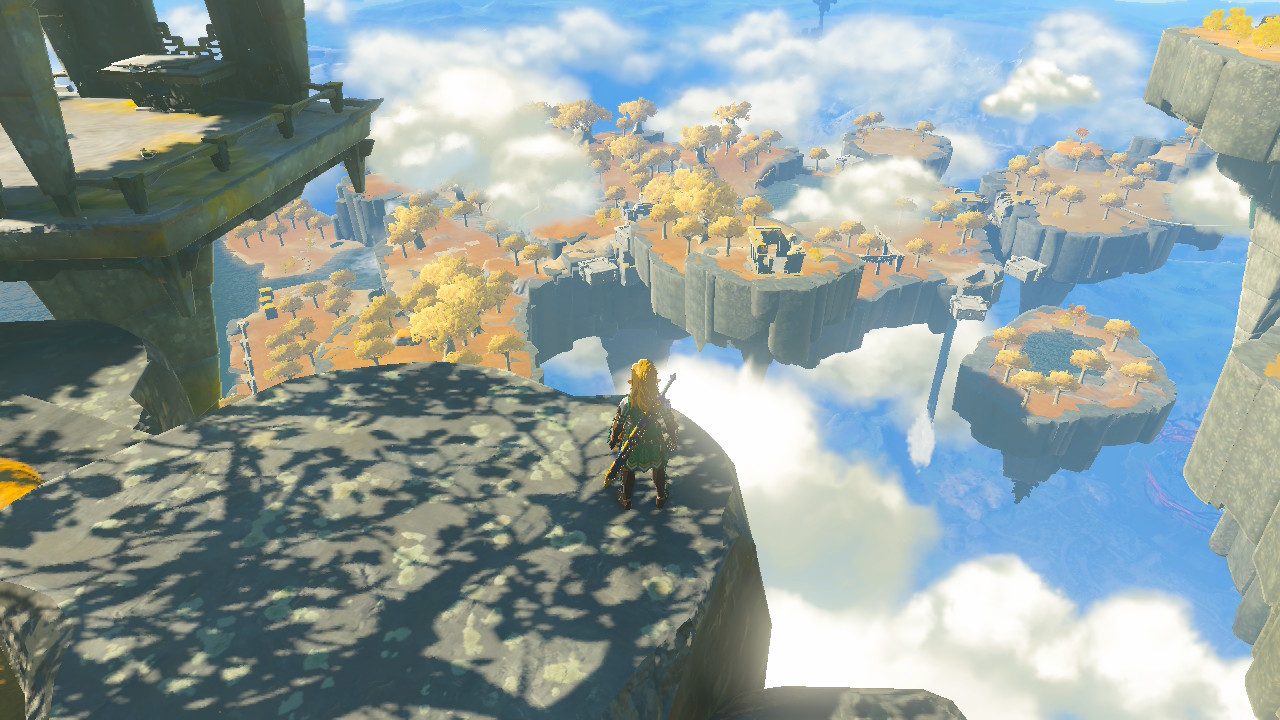
In representing the sky's sense of space musically, composers often reflect the small number of tangible features using harmony. As the player explores the Great Sky Island, they are accompanied by the track The Sky, which includes extensive harmonic ambiguity through the use of suspended chords and quartal and quintal harmony. More than half of the chords notated in Ex. 2.1 lack a third, cueing to the listener an instability in mode.
![The beginning of 'Sky Islands Main Theme' from The Legend of Zelda: Tears of the Kingdom, transcribed by Matéo Di Martino [2023] and organised by author.](/thesis/music/images/totk_sky.png)
While my transcription suggests C dorian, one could reasonably analyse this music in G dorian. By maintaining this harmonic and modal ambiguity, the composers ensure that there is no tonic for the player to latch onto—while one might briefly hum what seems to be the i chord, that "tonic" is likely to shift by the next bar. In doing so, the composers create a lack of groundedness, conveying that this environment is open to change, smoothly transitioning between different states. The music never lingers long in a particular mode, always shifting and cueing the player to this environment's lack of a resting condition.
Lena Raine's track Reach for the Summit for Celeste also features this modal ambiguity. In this game, the player's overall objective is to climb to the summit of a tall mountain by travelling through seven levels that slowly ascend towards that peak. In the seventh level, "The Summit", that goal is finally within reach as the player completes the last stretch of climbing the mountain. No longer are they surrounded on all sides by caves, but now half of the displayed screen is open sky. The player moves constantly upwards, rather than from left to right as is common in earlier parts of the game. Visually, this environment displays a distant sunrise lush with pink and orange tones, close and distant clouds, the mountain that the player is ascending, and vertical white lines that represent the moving wind, as shown in Fig. 2.3.
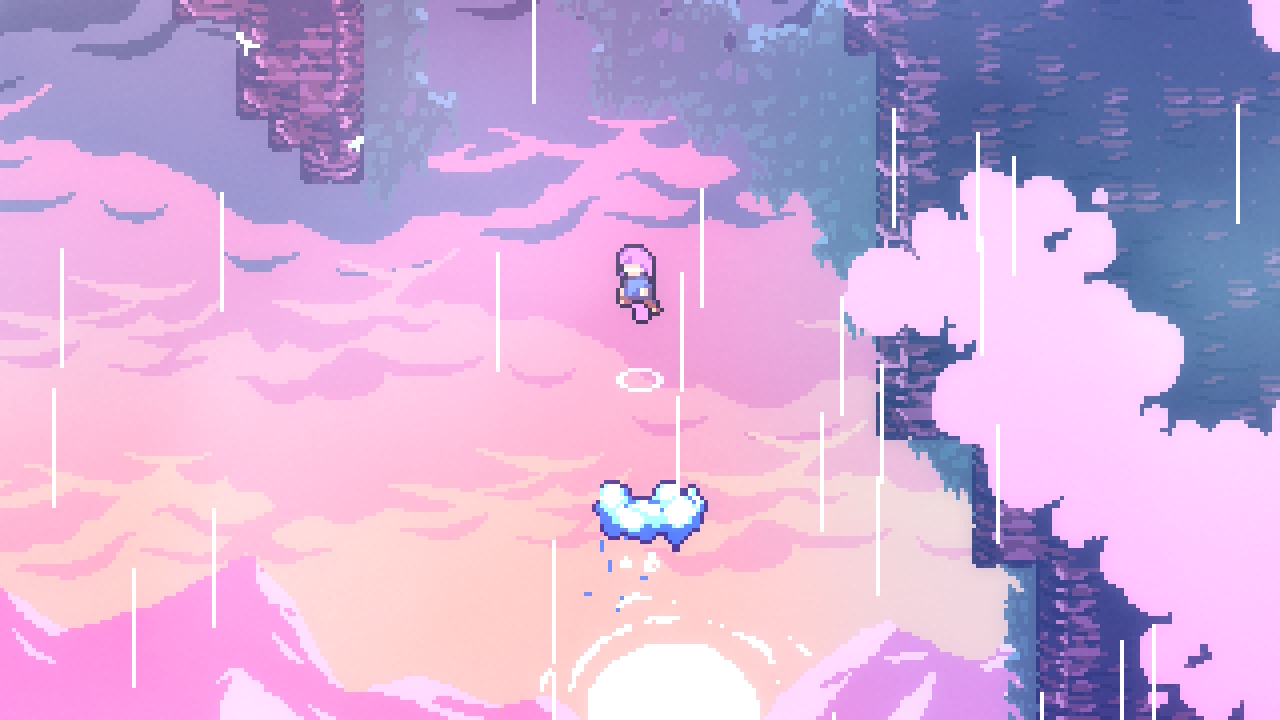
Reach for the Summit revolves around the primary ostinato notated in Ex. 2.2. This ostinato arpeggiates an Esus2 chord, tonally centring the music around E, but remaining harmonically ambiguous by omitting a third. By never resolving, the suspended second in this ostinato suggests that the environment is always on the brink of change, but has no "steady state" to return to.
![The primary ostinato in 'Reach for the Summit' from Celeste, transcribed by Shinkai Setsuna [2018] and organised by author.](/thesis/music/images/summit_ostinato2.png)
This allows the melody to fluidly shift between different modes of E, as seen in Ex. 2.3. While the track initially seems grounded in E major through the use of a G-sharp in the first bar, the fifth bar introduces a G-natural with a CΔ9 chord, reintroducing modal ambiguity through the use of a chromatic mediant. By combination of the suspended ostinato and the use of the I and ♭VI chords, Raine clearly conveys a key centre around E, but does not allow that mode to rest in either minor or major for very long. As with The Sky, this modal ambiguity has the effect of keeping the player ungrounded. While the emphasis on E in Reach for the Summit gives the player more to cling to than the constantly shifting tonic in The Sky, the player is constantly springing away from this home, never resting long in one state.
![The first melody of 'Reach for the Summit' from Celeste, transcribed by Shinkai Setsuna [2018] and organised by author.](/thesis/music/images/summit_melody.png)
One last example which makes use of suspended harmony is in Return to Dream Land, where the player completes the first part of the game by ascending a tower into the sky while surrounded by clouds. At one point in this journey, they find themselves traversing a land where orange-gold clouds make up the entirety of the terrain they traverse, as shown in Fig. 2.4.
![Ending segment of 'Nutty Noon: Stage 3' from Kirby's Return to Dream Land. Screenshot accessed from playthrough by BornLosersGaming [2024].](/thesis/music/images/kirby_clouds.png)
Accompanying this level is Jun Ishikawa's track Dreaming of Clouds. At this point in the game, the player has played through four "worlds", each of a different theme and consisting of a number of individual stages—starting in a forest world, the player must travel through a desert, ocean, and icy mountain before ascending to the clouds. For the player playing this game for the first time, this airy world called "Nutty Noon" seems to be the ending of the game as they ascend higher into the clouds, climbing towards a grand finale. This is not the peaceful beginning sky of TotK, but rather a sprint to the finish line similar to Celeste's "The Summit".
Ishikawa uses extended harmony—particularly a significant number of major seven chords and added ninths—in Dreaming of Clouds. As shown in Ex. 2.4, nearly every major chord in the first section of the track has one of these two chord extensions, and nearly every minor chord has an added seventh.
![Intro and first section to 'Dreaming of Clouds' from Kirby's Return to Dream Land, transcribed by SQUISHY_ [2022] and organised by author.](/thesis/music/images/dreaming_clouds.png)
Similar to how a suspended chord lacking a third creates a feeling of space by removing a feeling of groundedness, these chord extensions create a lifting sensation in the music that pushes the player away from a resting state. While Dreaming of Clouds stays tonally centred around C, Ishikawa also uses a significant amount of modal mixture, as seen by the prevalence of B-flat major, A-flat major, and F minor chords. This modal mixture again creates modal ambiguity, creating an ever-shifting harmonic background to represent the sky's experienced flux.
Several commonalities emerge in the chordal extensions that composers use when writing for the sky across these examples. Most striking is the frequency of the major ninth or suspended second, major seventh, and added elevenths or suspended fourths. By frequently omitting thirds, these composers remove a sense of grounding, allowing the music's mode to remain fluid, rather than fixed. For depicting an environment which itself is ever-shifting and intangible, this choice in harmony reflects a sense of atmospheric space. Through near-constant suspension, these composers hint at imminent atmospheric change, using notes that would typically resolve to a triad, then shifting to a new suspension without resolution.
The prevalent use of modal ambiguity in these examples also supports a lack of defined resting state. Both Reach for the Summit and Dreaming of Clouds make frequent use of a major I chord, but also use the ♭VI and ♭VII chords more often than the diatonic sixth and seventh chords. TotK's The Sky shifts between many tonal centres, starting around a sense of C, but easily flowing through related modes. In the same way that suspension creates a sense of space and non-resolution within individual chords, this modal ambiguity leaves the music suspended above the tonal centre through time. This is not a firmly grounded environment, but one in constant flux. By representing ideas of space and suspension central to a perception of the sky, composers call to the player's real-world experience of the sky as a shifting environment, expanding the video game environment to enhance player investment in the fictional world.
Moving Air
In games that utilise an expansive instrumentation, the instruments that composers use to write for the sky often reflect features of the wind. By giving important melodic lines to woodwinds, composers evoke the image of moving air, directly connecting the music to one physical feature of the sky. In using this instrumentation, the music engages in representation more directly: to form an image of the wind, the composers use moving air. The Sky presents this woodwind instrumentation most clearly. The primary instrument used in the track is a softly played alto saxophone, each chord swelling into perception, then fading out by the end of the measure. In addition to the alto saxophone, clarinets fill in the middle and lower voices, and a very faint violin plays a descant that gives the impression of hearing overtones from the winds. While the track remains musical, the soft entrances, swells, and fades of the woodwinds feel like the brief appearances of gentle gusts of wind.
Choosing instruments that create music using the passage of air to represent the wind is not a compositional choice unique to TotK. In Return to Dream Land, the primary melody of Dreaming of Clouds (Ex. 2.4) is carried by a clarinet, oboe, and flute at different points throughout the track. Similarly, in Skyward Sword, the player begins their journey in Skyloft, a peaceful village situated on a number of islands floating in the sky amongst the clouds. The first time this village is introduced to the player, the composers write a flute leaping between a D and an A accompanied by a guitar playing a Dsus2 chord, as shown in Ex. 2.5.
![Opening to 'Skyloft' from The Legend of Zelda: Skyward Sword, transcribed by Alec Weesner [2023] and organised by author.](/thesis/music/images/skyloft_opening.png)
The melody shown in Ex. 2.6 is quickly introduced on an accordion while the flute calls back to the perfect fourth leaps above the melody around cadences. This track plays for all moments when the player is outdoors in Skyloft, so that being surrounded by sky is associated with a sonic sense of moving wind. By contrast, the music that plays within buildings in Skyloft typically features much more prominent pizzicato strings supporting a piccolo melody that reminds the player of the outdoors without explicitly situating them outside.
![The primary melody to 'Skyloft' from The Legend of Zelda: Skyward Sword, transcribed by Alec Weesner [2023] and organised by author.](/thesis/music/images/skyloft_melody.png)
While woodwinds appear frequently in this music, however, these tracks do not foreground brass instruments, despite their similar use of the movement of air. This bias towards woodwinds is likely explained by strong associations between brass instruments and military bands [Herbert 2017: 5] or to other intense events such as hunting fanfares [Berlioz, Strauss 1991: 259].[2] While the timbre of woodwinds such as the flute is tied to a clear perception of moving air, brass has been more often heard in concert and military bands, shifting sonic affiliations away from the sky, and towards battle. Chapter 3 will analyse a combination of these cases with the track Colgera Battle from TotK, which situates a grand battle that takes place in the sky.
In creating a virtual environment of the sky that evokes the sensation of being outdoors, it is clear that video game composers make frequent use of woodwinds to create a sense of moving air. Using instruments that move air to create music calls to the nature of the sky, lending melody and harmony to what is normally perceived only as the sound of a gust of wind. Despite the player not hearing woodwinds as soon as they step outside in the real world, the use of this instrument group in video games immediately represents the wind, reminding the player of a primary feature of their environment. This distinction between the real world and virtual experiences of the sky is particularly interesting as it demonstrates that immersing the player is not necessarily an attempt to create a hyperrealistic sense of surroundings, but is rather an evocation of aesthetic associations with the environment that are represented through music. In this case, instrumentation invites the player to imagine the wind, using timbre to bolster a sense of the outdoors and surround the player with the sky.
Atmospheric Flow
In video games, the flowing nature of the sky is communicated through melodic structure, rhythm, and form. In video games, there are several contexts for which the weather—one of the atmospheric elements that Thornes identifies—is important to the player's sense of the environment, most notably appearing as either ever-present wind supported by a large degree of atmospheric movement, or as a lack of driving wind which creates a feeling of calm. These two categories are a useful simplification of the wider range of atmospheric possibilities that may be encountered in sky environments, which range from peaceful breezes to violent thunderstorms. This section will analyse compositional techniques that reflect the constant movement and flow present in the sky.
In Dreaming of Clouds and Reach for the Summit, Ishikawa and Raine use rhythm to convey this sense of movement. Dreaming of Clouds has four contrasting sections that promote a persistent groove forward with a drum kit and funk bass rhythm. The kick drum on quarter notes plays against a syncopated piano to create rhythmic complexity without sacrificing a clear pulse. These rhythms are most complex in the second section of music, where the electric bass arpeggiates the harmony by sliding between notes. In the fourth section, however, this rhythmic density largely vanishes, the pulse provided only by a triangle and the piano while the bass holds a pedal and the drums drop out. This sudden rhythmic contrast creates a sense of momentary suspension, a brief moment of calm. By alternating between highly rhythmic sections and sparser ones, Ishikawa creates rhythmic flow throughout the form, alternatingly representing moments of high atmospheric density and gaps of space.
Similarly, in Reach for the Summit, Raine writes a highly syncopated percussion section, consisting at times of a shaker, a drum set, or synthesised percussive clicks. In writing this complicated texture, Raine does not sacrifice a sense of pulse. Each downbeat is very clear, the eighth note ostinatos and a snare or claps on even beats clearly maintaining a forward drive that propels the player through the level. In Celeste, it is clear that the atmosphere is quite windy, as can be seen visually by the white lines that travel across the screen in Fig. 2.3. While tracks in windy environments are not the only parts of video game music that have strong grooves, it is notable that games where there is a significant amount of wind are accompanied by high-energy music. This music indicates that large weather shifts can be emphasised through highly syncopated music with driving pulses that represent the dense movement of air. Variations in this rhythmic complexity create flow in time, evoking the constantly changing nature of the sky through form.
In contrast to the complex rhythms of these two tracks, The Sky is particularly interesting for its notable lack of pulse. Rather than being driven by a percussion groove or rhythmic motive, each measure fades in and out of the atmosphere at seemingly random moments. This flowing sonic atmosphere supports an environment in which, though the player has a specific goal to pursue, they are free to explore their surroundings as they wish with no time pressure. Rather than representing a constant wind, The Sky builds the environment of a soft breeze that briefly enters the atmosphere, noticeable only for a bare moment.
This distinct swelling and receding in The Sky is not entirely missing in the other three examples, most prominent with an analysis of melody and form. Melodically, Dreaming of Clouds promotes the rhythmic motive often heard in the first section shown in Ex. 2.4: a dotted quarter note, eighth note, and quarter note. The melody's clarity in this opening section primes the player for recognising the return of the tune later in the track as it is passed between several instruments. Between melodic sections, Ishikawa writes non-melodic, textural sections that have a more soloistic feel. By alternating between sections that clearly carry this melody and ones that are more rhythmic or textural with no distinct melody, the music flows between states, representing a shifting sky.
Reach for the Summit conveys a similar sense of flow through melody. The first melodic section follows a double period structure, as shown in Ex. 2.3. Notably different between the antecedent and consequent group is the sense of elongation created by the whole notes at the beginning of the phrases in the consequent group. Whereas the antecedent group maintains the music's forward drive using eighth notes, the melody is far less active in the consequent group, the drive instead carried by a rhythmic acceleration in the strings filling inner harmonic voices. In addition to elongating melodic gestures through simplification, Raine also creates flow through dynamic swelling. The melody often powerfully introduces phrases, receding towards the end of each bar. Through this change in dynamics, Raine again creates a sense of flowing in time, shifting between strong gusts of wind and the moment of brief stillness between breezes. In addition to melodic flow, embellishing synthesisers fade in and out of the mix, arpeggiating harmony to create a rising and falling motion as they appear for the briefest moment before receding into the background.
The primary melody of Skyloft (Ex. 2.6) also conveys flow through shifts in character created by changes in instrumentation. In the first section, the accordion carries the melody, accompanied by a guitar and bass arpeggiating harmony, a tremolo mandolin in a high register, and a violin holding long notes for harmony. Then, a new melody is passed between a horn, the accordion, a flute, and the violin, displaying a number of instruments working together to carry a single line that does not linger long in one place. Similar to Reach for the Summit, this dovetailing leads to dynamic flow in the melody: the beginnings of phrases powerfully introduce ideas, then fade through the rest of the line. By often passing the melody between instruments, Skyloft does not linger long in one place, always flowing between musical states.
This creation of flow in different sky environments is perhaps the most interesting form of musical representation for the sky, displaying a variety of techniques that together influence how this environment is perceived. Even in tracks that use constant groove to urge the player to move quickly amidst howling wind, composers use melody and form to create environmental swelling and receding. Unlike the visual artists that Thornes discusses, composers are not creating a still image of an environment meant to capture a single frame of the sky. By being a time-based medium, music can go beyond solely alluding to these fundamental features by forming a sensation of what it means to be a part of the environment. When one steps outdoors, they do not simply see the colour of the sky and the texture of the clouds, they feel the expansion of space, the small fluctuations in wind through the environment. In video games, composers use music to bolster the visual atmosphere by incorporating time-based changes that dynamically represent the sky. Changes that occur within bars, phrases, or throughout the whole piece with form evoke the sensation of being immersed in an environment of constant change, not only telling the player that they are in a sky, but communicating information about that sky's quality and character.
Caves and the Underground
Perception of the Underground
Far less present in most people's everyday lives than the sky, the cave presents an atmosphere where, rather than being surrounded by open space, the sky is fully blocked from sight by rock on all sides. In a publication identifying the general physical features of caves, geologists I. M. Morgan and W. E. Davies describe this environment as "a natural opening in the ground extending beyond the zone of light" [1991: 2], citing a number of geological processes that can lead to the formation of a cave such as ground water eroding rock over time, tunnels left by lava passages, and sand blasted by wind slowly forming crevices in the earth [3-5]. In each of these cases, a natural material slowly forms these underground caverns, which eventually develop features such as stalactites, stalagmites, and mineral deposits [8-13]. Changes here do not occur on the timescale of days, but on that of millennia.
In video games, these defining characteristics of caves are often visually depicted in environments where the player finds themselves fully underground with no trace of the sun's light. As with the sky, the role of the cave can vary significantly, with some games such as TotK having the player venture into the underground as part of the narrative, while other games such as BotW do not significantly tie caves to the story, leaving their visit optional to the player. Other games, such as Hollow Knight, take place almost entirely underground, featuring a wide variety of thematic caves including overgrown mossy regions and ones where magma runs through the walls. In each of these game environments, the cave presents a region separate from the outer world. There are distinct moments of entry and exit from the underground, a transition made significant by the coming and going of the sky.
Aside from the physical features of the cave, this environment creates a sense of stillness associated with the timescales for which formation changes occur. To enter a cave is to enter a space where time seems to freeze as geological processes take so long to occur as to be completely imperceptible. Cultural geographer Harriet Hawkins describes one experience of being in a cave, writing "we did pause often to reflect on the press of geology, on the feeling of being amidst millennia, smoothing with hands rocks shaped by thousands of years of running water" [2020: 8]. Through the exploration of the cave as an environment that may provide a respite from troubles in the outer world, Hawkins frames the underground as a location carrying thousands of years of geographic history, an unchanging place that exists out of the ordinary. This framing is significant in its large contrast to the sky. Whereas the sky is experienced largely through its changes, the cave is instead experienced in its stillness.
This timeless perception of the underground has contributed to a number of symbolic interpretations of the cave. In an investigation into perceptions of this environment by connection to the role of the underground in visual culture and spiritual practices, Mark A. Cheetham and Elizabeth D. Harvey describe the cave as an origin source, writing that caves "are imagined as a record of an originary moment in human creativity" [2002: 105]. Since caves are not a typical part of everyday life, perception of this environment often leans towards this symbolic imagery rather than recurring physical experiences. The authors provide one example of this imagery, writing abstractly that "artists and theorists" reproduce caves as "projections of inspiration or of the mind itself", existing "between interior and exterior, between materiality and transcendence, between the seen and the unseen" [106]. This description of where the cave "exists" demonstrates that perception of this environment moves beyond simply the recall of physical features that define a cave. The authors frame the underground as a liminal space that acts as a transition between different modes of thought, not itself defined by its physicality, but more understood through its symbolic meanings. As Hawkins writes, "The underground has long been a site to which humanity turns – intellectually, imaginatively and literally – when its ways of life are under threat" [2020: 16]. In this reading, the cave is an environment of respite, a calm region that serves as an escape from the world when needed. Combining these perceptions of the cave's symbolic interpretations, this environment becomes an ancient source of origin, a respite from the world, and a transition between states of consciousness. This is an environment that, despite having physical presence, is conceived of more through the abstract impressions it creates rather than solely by the recollection of its material details.
In addition to philosophical consideration of how the cave as a space is perceived, several psychologists have investigated the physiological and psychological effects of being inside a cave. These studies were conducted with the intention of using the results to make predictions about human response in space and aerospace conditions, identifying several psychological effects correlated with extended isolation in underground caves. Amongst the findings was an observed dilation of time perception caused by the darkness of the cave environment impacting circadian rhythms [Zuccarelli, Galasso, Turner, Coffey, Bessone, and Strapazzon 2019: 14]. While players cannot be expected to experience the same phenomenon by sitting behind a screen, it is noteworthy that this study found that prolonged darkness leads to a disruption of natural human cycles. This darkness is a key component of the cave environment, characterising the unknown all around and the distortion of the familiar created by being surrounded on all sides by shadow with no references to the passage of time in the outer world. While their finding that being inside a cave disrupts the body's natural cycles cannot be directly applied to the experience of a cave in a game, this result is significant in demonstrating the strangeness intrinsic to a perception of this environment. While the sky is familiar, the cave is a space of unknowns, an environment that exists outside the normal.
In a similar investigation into using phenomenological experiences of caves as an analogue for spaceflight, neurologists and psychologists identify a number of sensory inputs that are warped by the structure of the cave. They write that "many cave environments have continuous background noise from wind and water movement", and that "lighting in caves is produced by headlamps, which create partial, focal illumination of complex three-dimensional spaces and complicates movement and navigation" [Mogilever, Zuccarelli, Burles, Iaria, Strapazzon, Bessone, Coffey 2018: 9]. In games, lighting does not come from headlamps, but rather from a number of different sources that can either be diegetic (such as a torch on a wall), or non-diegetic (such as a baseline light level coded into the game engine that prevents the screen from being pitch black, even if the torch is removed). These light sources can similarly warp the visuals displayed on screen, shrouding the atmosphere in darkness while leaving the player partially illuminated at the centre of the screen. The study further identifies the atmospheric contrast this presents when compared to the outdoors: whereas outdoor environments are well-lit by the sun, caves subvert familiar interactions with light through the use of many light sources that distort visual perception of space. In discussing the sonic features of the cave, the authors specifically describe these sounds as "background noise", situating the sonic atmosphere as a collection of peripheral elements. Whereas sources of sound are often visible when outdoors (leaves moved by the wind visibly tremble, a fox leaping through a bush creates a distinct rustle), the authors provide examples of background noises that are likely not visible or tangible (the distant echo of wind or water), further differentiating the cave environment from that of the outdoors and indicating that in addition to a visual distortion of space, the cave also presents a sonic distortion of space.
As composers write for cave environments, they may write musical features that evoke this disorienting nature of being underground. Using musical representation, they at once convey the environmental contrast between the underground and the outdoors and communicate the perceived qualities of the cave. The music in this environment situates the player deep underground, distorting light and sound while creating a sense of stillness. The remainder of this chapter will analyse how composers write music meant to evoke these qualities of the cave in the games Super Mario Bros., BotW, Silksong, and Ori and the Blind Forest (Blind Forest) [2015].
One of the most well-known underground themes comes from the Super Mario Bros. game series by Nintendo, where the player, playing as "Mario", must traverse the "Mushroom Kingdom", dodging and defeating enemies along the way. In many 2D Mario games, the player is situated above ground in the first level, and must venture underground in the second, upon which they hear the Underground Theme by Koji Kondo, transcribed in Ex. 2.7.
![Mario 'Underground Theme' by Koji Kondo, transcribed by Ashanti Mills [VGLeadSheets] and organised by author.](/thesis/music/images/mario_underground.png)
The original Super Mario Bros. does not fall under the category of games that target building immersivity due to its greater similarity to an arcade game than to a narrative game. A later game in the same series, New Super Mario Bros. U [2012], does however fall under this category of immersive narrative games, and composers Shiho Fujii and Mahito Yokota reuse the Underground Theme as a motive upon which to write a new cave theme with expanded harmony and rhythm. This section will primarily analyse the modified track written for New Super Mario Bros. U, but it is notable that a cave theme written in 1985 has persisted across a number of games and decades to represent the Mario underground.[3] In BotW, caves do not make up a primary component of the gameplay, but are scattered across the world for players to find and explore. In both Silksong and Blind Forest, the player interacts with a variety of caves throughout their journey through the world, passing through different thematic manifestations of the underground. This section primarily analyses stone-based caverns in these games (as opposed to volcanic or crystalline caves) to remain focused on an image of the underground independent of other elemental influences.
A Transition from the Outer World
A central component to the perception of the cave is the transition that marks a substantial shift in atmosphere from the above-ground. Moving from a region with open access to the sky to one of warped sight and sound where the player is fully enclosed by stone creates a significant distortion of space. To emphasise this shift in surroundings, video game composers often employ changes of register, tempo, and instrumental tone to create contrast with and mute the outside world. For example, the Underground Theme that plays in the second level of New Super Mario Bros. U—called "Tilted Tunnel" and shown on the right in Fig. 2.5—presents a significant deviation from what is heard right before the cave theme. Directly before entering the underground, the player is running through the grassy terrain shown on the left of Fig. 2.5 to the playful tune Acorn Plains, which plays at 110 BPM with a funk bass, melody carried by a synth, and short vocal accents.
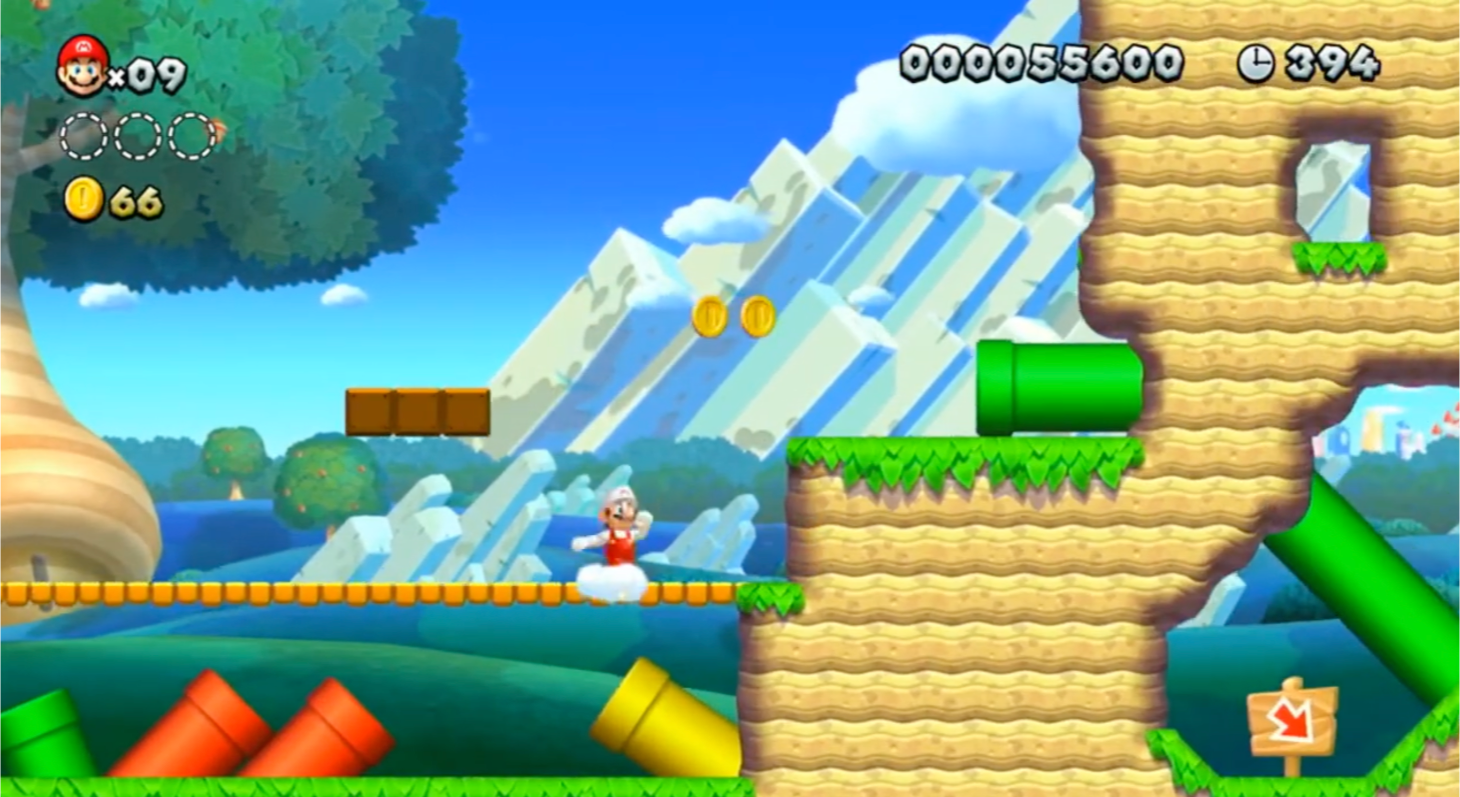
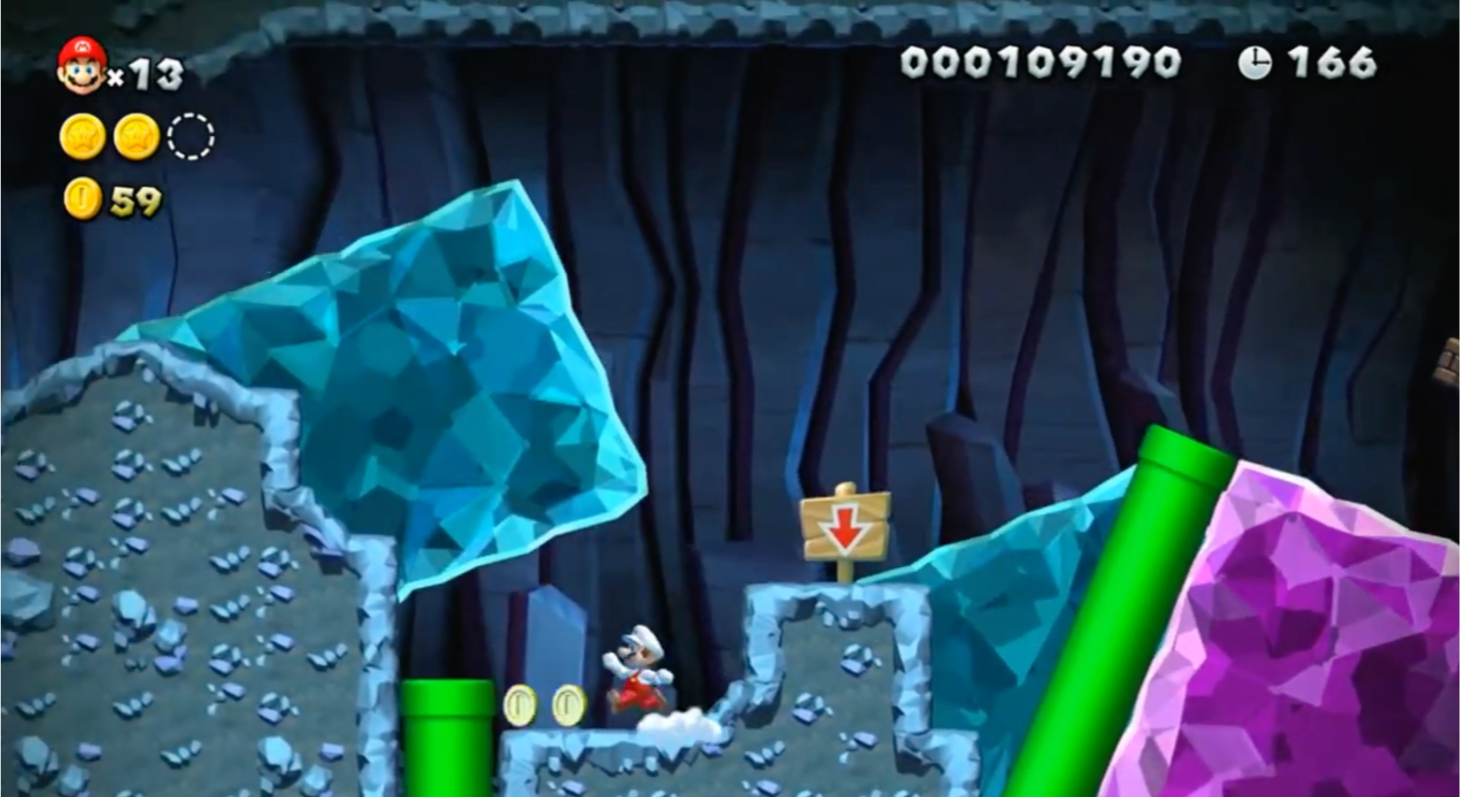
Accompanying the track is a constant high-pitched tambourine playing sixteenth notes, urging the player to frolic through the level. As soon as they enter a pipe and descend to the underground, however, the Mario Underground Theme plays, retaining a similar instrumentation, but shifting to a much more chromatic melody and a slightly slower tempo of 98 BPM. The constant, driving tambourine is gone, replaced by a syncopated, dark shaker that creates a sense of creeping, rather than running as above ground.
In this Mario game, the cave theme is less representative of the cave in isolation, and more useful for analysing how music can create immediate contrast in environment. When entering a cave, one experiences a distortion of visual and sonic space [Mogilever, Zuccarelli, Burles, Iaria, Strapazzon, Bessone, Coffey 2018: 9], emulated in this track by the increased use of syncopation and embellishing material in Underground Theme as compared to Acorn Plains. As the player progresses underground, the melody is passed to the bass, and high frequencies are reserved only for textural elements. By this point, the player has built a sense of what it means to be in the outer world, and this track sonically disrupts that sense. Unlike transitions between two outdoor environments, this is one that significantly warps the world, closing off the sky and marking a substantial change from the ordinary.
For the game composer, this indicates that shifts in atmosphere are an important part of conveying qualities of an environment. When a player moves between two distinct spaces such as the Mario above and underground, the contrast between sonic environments can indicate significant environmental change. This sonic contrast quickly sets the groundwork for more specific representation of the cave. Other games have more representationally evoked the cave through the use of audio mixing and production tools to create space and echoes, and a musical sense of timelessness crafted by slow harmonic rhythm and instrumentation.
Echoes of Space
One quality of video game music which I have so far implicitly relied upon is that all video game music is heard as a mixed and mastered recording of real instruments or virtual instrument samples, rather than as, for example, a live string section playing in the same room as the player.[4] Unlike a concert hall, where the sound is extremely dependent on the acoustics of the room, video game composers and sound designers have a large degree of control over exactly what the player hears, moderated only by how the player listens to the game's audio (with or without headphones, for instance). Many times, this mix plays a lesser role in what the player hears than the music itself, but in some cases such as the cave, mixing decisions become more perceptible.
The most noticeable mixing tool used in the cave environment is the addition of reverb to emulate the echoes one would hear from making sound in a cave. This creates a different sense of space than that of the sky. Whereas the previous section identified the sky as an open, shifting environment with no steady state, the cave is nearly the opposite. The underground instead blends earth and darkness, where at once, one experiences the millennia of unchanging history and origin beneath their feet [Cheetham, Harvey 2002: 105] and is surrounded by isolating darkness that seems to extend to infinity [Zuccarelli, Galasso, Turner, Coffey, Bessone, Strapazzon 2019: 1]. Hidden in these shadowy depths are unseen sound sources that echo through the caverns (dripping water, falling stones), every sound amplified by the harsh stone walls. By using reverb when mixing audio, composers can sonically recreate this expansion of sound and space, mimicking the auditory environment of the cave. In New Super Mario Bros. U, for example, Fujii and Yokota arrange the Underground Theme to create this broadening of atmosphere. A number of embellishing elements are added into the mix, including small echoes of the melody on different instruments, triangle taps, accentual chromatic runs, and held tones that maintain the music's atonality. Meanwhile, the melody remains in a low register throughout the entire track. The mix in this re-arrangement features an increased level of reverb, heard most notably on the snare and the embellishing musical elements. This reverb brings out the textural elements by hinting at distant echoes, creating a widening of space representative of the cave that mimics the environment's distorted sound.
The track Down the Moon Grotto by Gareth Coker from Blind Forest displays a similar range of embellishing atmospheric material in non-melodic parts of the score. In this game, the player must travel through the game world "Nibel" to restore balance and save a dying forest. At one point in the game, the player explores a region called the "Moon Grotto", shown in Fig. 2.6.
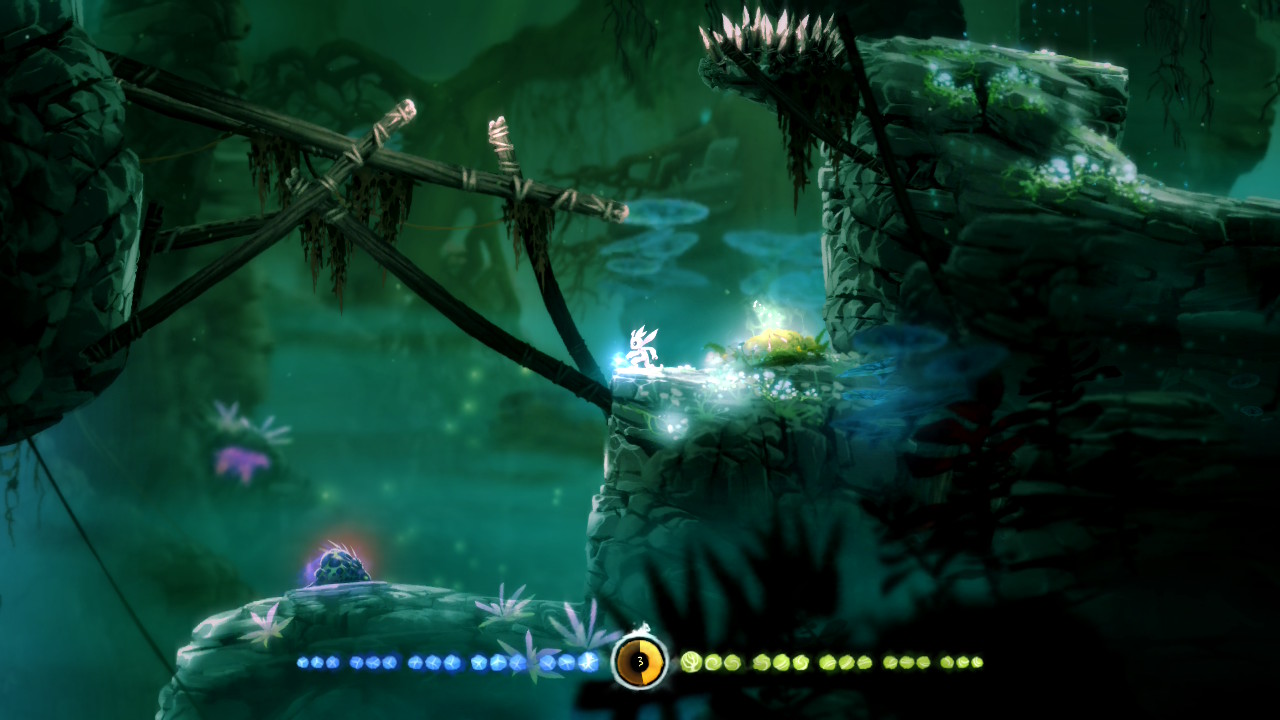
This environment presents a dark cave of blue and green tones where the player is often fully surrounded by rock. There are many glowing plants and fantastical vines growing throughout the region, maintaining an environmental sense of life. As they progress through this environment, the player is often faced with dangers such as spikes (shown at the top of Fig. 2.6) or enemies (the purple "spine slug" in the bottom left of Fig. 2.6). In these passages, Coker creates atmosphere through held choral tones and echoes of melodic motives. A tambourine accompanies a high-reverb steel drum line that leaps between A and E, maintaining both a sense of rhythm and a drone on A minor while notably lacking a melody in many sections. In such non-melodic parts of the music, Coker alternates between writing cello and bass pizzicato and times when the low strings fully drop out. Featuring primarily textural musical material, these sections invite the player to listen for distant echoes, rather than prominent melodies. Mixed with the reverb on the tambourine and steel drum, this track creates a sense of a cavernous space that extends far beyond sight where these distant sound sources may exist.
Expanding on this sense of space, Christopher Larkin's score to Silksong uses instrumental range to create the broader sense of the cave. Over the course of the game, the player must ascend from deep in underground caves to the peak of a grand citadel. These beginning caverns vary greatly, with some overgrown and lush with moss, while others, such as The Marrow, are rocky and full of shadow as shown in Fig. 2.7. A large part of The Marrow fully surrounds the player by stone and shadow as they explore confining caves while fighting enemies and avoiding spikes (bottom of Fig. 2.7). In more open spaces of this region, the player sees hints of magma that indicate that they are deep underground and foreshadow a later, fire-based region of the game called Deep Docks.
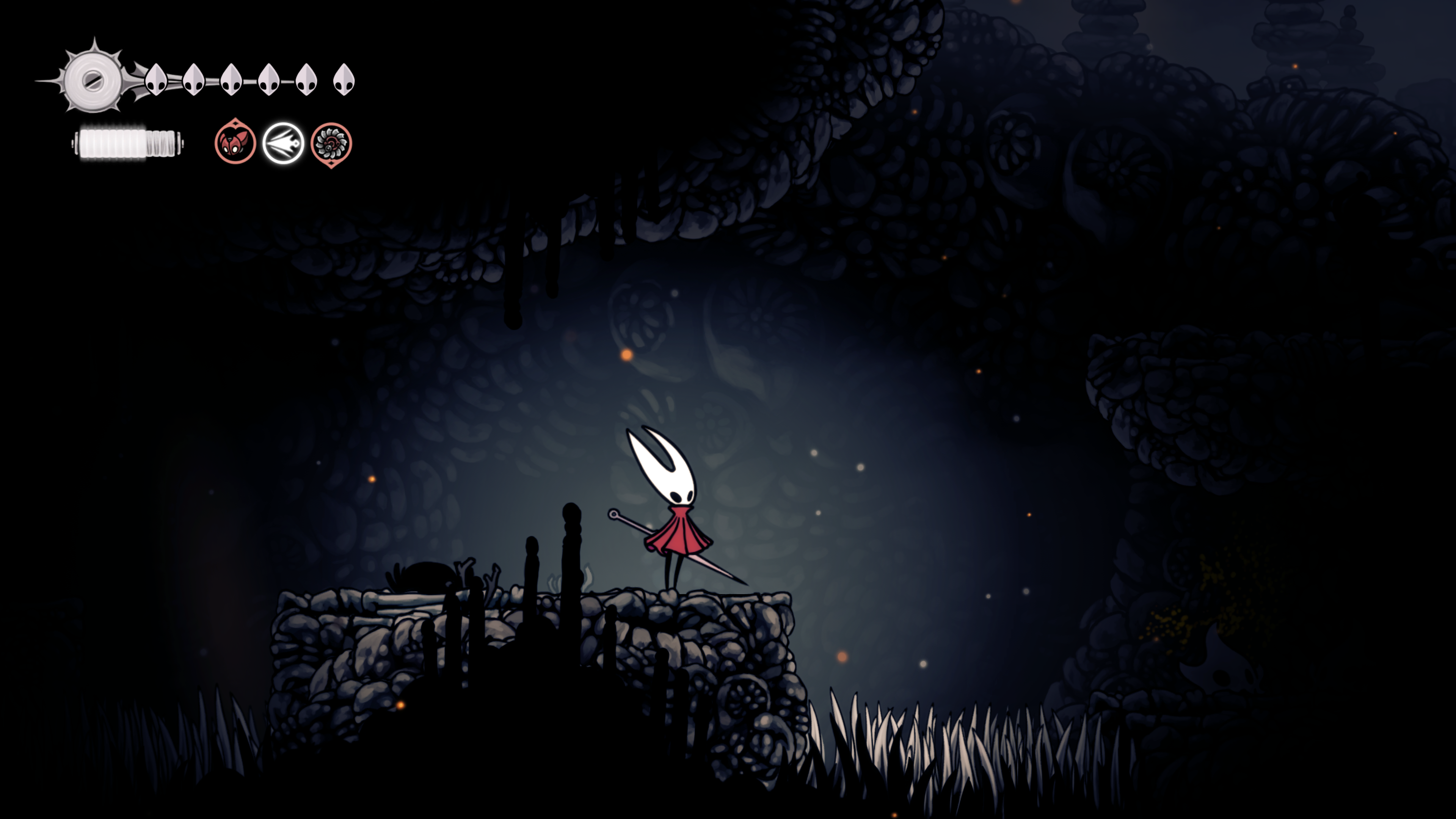
Creating a resonant cave space when composing for The Marrow, Larkin chooses an instrumentation that allows for exploration of a broad sonic range. Low brass plays root notes at the bottom of their range, a gravelly timbre upon which choral voices fill harmonic inner voices and a high solo violin carries the melody. On top of the sustained harmonic foundation that plays primarily i, V, and ♭VI chords (shown in Ex. 2.8), the melody soon shifts to a viola, narrowing the upper range of the track.
![Introduction to 'The Marrow' from Hollow Knight: Silksong, transcribed by MuseScore arrangers [2025] and organised by author.](/thesis/music/images/marrow_intro.png)
By keeping a constant foundation in the lower voices and shifting the upper ranges of the music, Larkin directly evokes the image of the cave, that underground region where aeons of earth stand below the player, yet the ceiling can be either far off and open or close and confining. This instrumental range supports the narrative by reminding the player that they are at the bottom of their journey upwards, and that a long climb awaits. Contributing to a resonant atmosphere, many instruments and synthesisers hold a drone as the melody unfolds. Sometimes, this drone is held in the brass, other times in the choir, and the entrance of new drones always briefly overlaps with the fading of old ones, creating a layering effect that diminishes the importance of individual instruments in favour of an overall sonic atmosphere. While the melody remains the focus, the rest of the mix is saturated with reverberating echoes and sonic information from a variety of sources, building the foundation and history of the cave while alluding to a sense of grandeur and space.
Composers use reverb, musical embellishments, and range to sonically imitate the soundscape that one experiences while inside a cave. The prevalence of reverb in these tracks evokes the distant echoes of the environment, non-melodic musical accents saturating the atmosphere to create complexity that leads to a warping of sonic space. As with the use of woodwinds in sky environments, this mixing calls to the player's literacy of what it is to be in a cave, surrounded by distant echoes and extending darkness. Low drones and pedals contribute to a deeper perception of the cave, alluding to centuries of history embedded in rock below the player and situating them not only in a two-dimensional image depicted on the screen, but in a broader world surrounded by earth, the sky hidden from view.
Evoking Timelessness
As identified by Hawkins and psychologists investigating human response to caves, the underground represents an ancient environment of slow changes, where often, the only sensory input is a "continuous" background noise. Composers use slow tempi, harmonic rhythm, or instrumentation to create this sense of stillness and lack of change over time. For instance, Larkin's theme to The Marrow unfolds slowly, both melodically and harmonically. The first thematic material begins at the start of the track with a parallel period, as transcribed in Ex. 2.8. While the melody begins on the i chord in the antecedent phrase, the same starting notes are harmonised with the ♭VI chord in the consequent phrase, hinting at progression while repeating thematic material. Noteworthy about this theme is its slow tempo of about 48 BPM. While strings and low percussion make it clear that there is a pulse to the music, the theme takes about forty seconds to play the eight bars notated in Ex. 2.8, creating long suspensions without significant harmonic movement. By using such a tempo, Larkin creates a sense of repose, where the player is encouraged to proceed through this ancient atmosphere without rush. Through slow harmonic rhythm and single melodic lines carried by either a solo violin or choral voices, Larkin evokes a sense of stasis and history akin to what one might feel upon entering a cemetery: this is not a region to sprint through, but rather one to respect for its stillness and permanence.
Creating a similar sense of atmospheric stillness through harmony, Down the Moon Grotto remains entirely diatonic, grounding the music in A minor. The melody is heard on a clarinet, piano, and flute, and is shown in Ex. 2.9 with a reduction of the pizzicato strings that provide harmony shown below the melody.

This theme consists of two similar phrases repeating a melodic motive (the sequence of A–E–D) at the beginning of each subphrase. Harmonically, nearly every bar remains on the tonic, with only a brief shift to the iv56 chord in the second half of the third measure of each phrase. This lack of harmonic movement again creates a sense of stillness—despite the melody's movement and the textural embellishments, this environment is not one attributed with a great deal of flux. Rather, the repeating motives in the melody and slow harmonic rhythm indicate that changes take time to unfold; any shifts in the atmosphere are imperceptible.
BotW similarly uses a slow tempo (quarter note 36, as shown in Ex. 2.10) to evoke the cave shown in Fig. 2.8 through the game's Cave Theme.
![The Legend of Zelda: Breath of the Wild 'Cave Theme', transcribed by L Marisson [2020] and organised by author.](/thesis/music/images/botw_cave_score.png)
In the "Hebra Great Skeleton Cave", the player finds themselves in a very sparse cave environment with few features other than the walls, ceiling, and occasional boulder. This environment creates atmosphere through the use of fog which limits visibility (as can be seen by the greenish tint in Fig. 2.8) and the blue-grey colour of the stone walls that alludes to the frigidity of this cave, which is located beneath a snowy mountain.
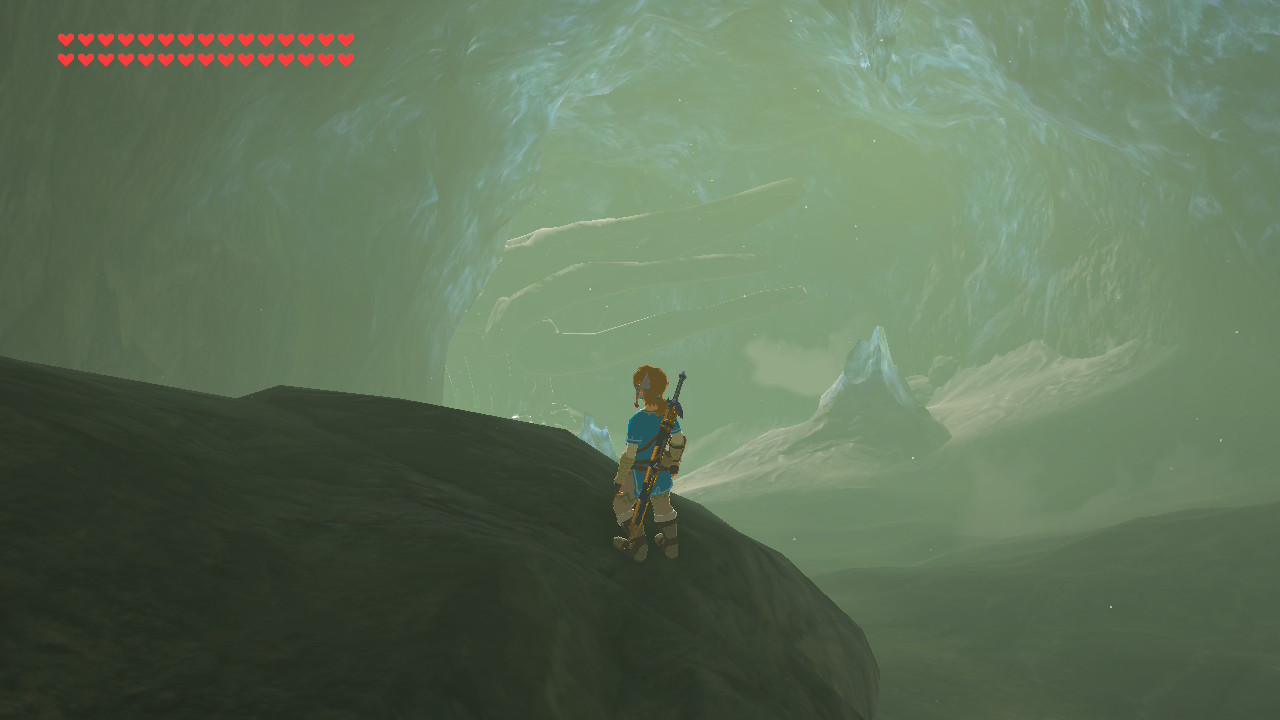
The Cave Theme has a steady pulse that is interrupted only by a fermata on the final note of each phrase: between a piano very clearly marking downbeats and a melody synth playing beats two and three, this theme clearly outlines a simple triple metre with few shifts in rhythm. No single note is held for longer than three beats, leading to a sense of fading echoes rather than suspension, as if the sound was made once, lasted for a moment in the space, then dissipated. Whereas The Marrow and Down the Moon Grotto use harmonic suspension to convey lack of change, the Cave Theme uses this rhythmic regularity to create a sense of unchanging familiarity. The repetition of a piano arpeggiating chords on each downbeat signals a lack of change, calling to the cave's timelessness. By only playing on beats two and three, the primary synth adds to this regularity, representing Hawkins' interpretation of the cave as an ancient site that has existed unchanging for millennia. This theme becomes an echo of the cave's static nature, representing the grotto as a space of respite and comfort where, no matter what complexity occurs in the outer world, the environment encased by stone remains a constant.
Through either a slow tempo, slow harmonic rhythm, or a combination of the two, these cave themes sonically represent the slowly shifting nature of the cave. By repeating rhythmic or melodic ideas such as in the BotW Cave Theme, composers represent the ancient and continuous sensations that Hawkins, Cheetham, Harvey, and psychologists associate with the cave, situating the player within an environment where change happens on timescales of thousands of years, rather than seconds or minutes. The cave becomes a warping of the exterior world, one that exists as a brief, dark gap between millennia of history and confining stone walls that threaten to suffocate. This is an environment where very little changes, one where the smallest sound will be heard back as an echo. By evoking these qualities of the cave environment, composers and sound designers place the player in a foreign location not typically experienced in everyday life that creates a damping of all that is familiar.
Conclusions
Using music to represent an idea appears across a variety of genres and styles, conveying images or stories without the use of language. By utilising musical representation, composers for narrative video games craft sonic environments that complement the ones seen on the screen and constructed in players' imaginations. This music differs across environments, using compositional techniques such as form, harmonic rhythm, and instrumentation to appeal to the player's literacy and create a world beyond that depicted by the visuals. Analysing musical representation in these environments contributes to a greater understanding of how music can create a sense of the world within which players ultimately become invested and immersed, describing musical techniques composers might utilise to craft imagined worlds.
In sky environments, composers can create a sensation of the wind by building a sonic sense of space, giving melodic lines to woodwinds, and by conveying a sense of flow through melody and form. The scores to these video game skies create this sense of space through modal and harmonic ambiguity, often incorporating suspended chords without thirds and adding extensions such as major sevenths, ninths, and elevenths or raised fourths. This modal ambiguity often comes from a large degree of modal mixture, alluding to the idea that the sky has no rest-state, but is instead experienced through its ever-changing nature. Woodwinds remind the player of moving air, clearly representing the winds that one would feel from stepping outside. This flow of wind is supported by oscillations in complexity of melody and form, the music in this environment flowing between moments of density and ones of space. By utilising these musical elements, composers can contribute to a greater sense of space than that seen only in the visuals, immersing the player in a wider, open sky.
As the player travels underground to the caves, they find themselves closed off from that open sky, surrounded by millennia of unchanging stone. Composers utilise drastic changes in tone and range to represent this transition to the underground, using mixing techniques, tempo, harmonic rhythm, and range to convey the timeless sensation of being deep in a cave. Incorporating mixing tools such as reverb, composers can imitate the sonic atmosphere one would experience from being in a confining space surrounded by hard stone, creating the impression of echoes travelling through the environment around the player. Central to the perception of the cave is its static nature, reflected sonically by extended drones on a single chord and slowly moving melodies. Through these musical tools, composers create a warping of space and time, immersing the player in an environment not only characterised by being surrounded by rock deep underground, but also by its impact on the senses as the familiar world above vanishes.
While this chapter focused on two specific environments in video games, narrative games feature many more regions, such as those lush with forest undergrowth, frosty with ice, or roaring with magma. Each of these regions has its own sonic associations, and there is great value to be found in analysing the many other environments that appear across games. In particular, the elements that I have identified here as being common to the sky and the cave may not be entirely unique to these atmospheres: a dense forest that blocks out the sky, for instance, may utilise features of enclosure that are found in the isolation of the cave. Studying more of these extreme, fantastical regions depicted in games would further an understanding of how composers perceive the natural world, and how music can translate that perception into shared art.
Musical representation of the environment provides composers with an effective way of enhancing the player's sense of the world, but it is not the only musical tool available to composers that contributes to immersivity. Essential to player immersion is the game connecting with the player through the creation of affective ties. Aside from composing music that builds investment by situating the player within the game world, composers also write experiential music that gives the player a purpose within that world, as will be investigated in the following chapter. This purpose leads to a deeper level of player immersion, where the player has now built emotional ties to the world, characters, and story, and finds themselves fully transported into the fantasy environments.